Walk into a dry fruit store and you will see dates sold with seeds, and others labelled "seedless" or "pitted". Which should you buy? The answer in the seedless vs seeded dates question depends on how you plan to use the dates, how quickly you will eat them and how much you care about price per edible gram. Seeded dates tend to stay fresher and cost less per kg, while seedless dates save time in baking and are safer to serve to young children. This guide compares them on taste, freshness, price, nutrition, safety, waste and best uses, explains how seeds are removed and how to decide for your household.
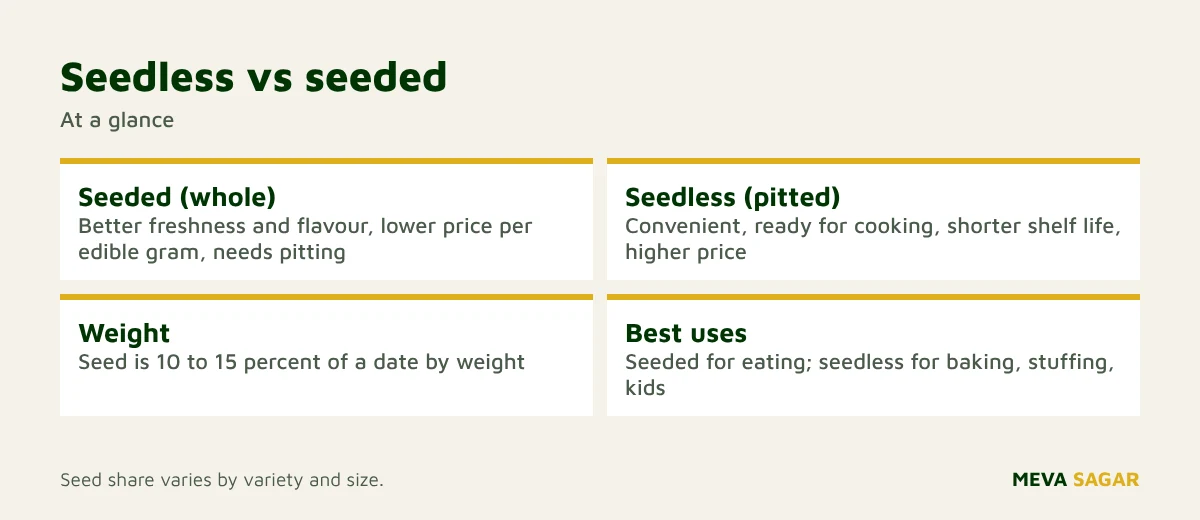
Quick answer: Seeded dates stay fresher longer and cost less per kg of edible fruit, but need pitting. Seedless (pitted) dates are convenient for baking, stuffing and young children, but are more processed, dry out faster and cost more per edible gram. Buy seeded for eating and long storage, and seedless for recipes and convenience, in small quantities.
How seedless dates are made
Dates naturally have one long seed. "Seedless" dates are not a separate variety; they are dates from which the seed has been removed, usually by machine, leaving a slit or hole. Some varieties are more often sold pitted, such as Medjool, Deglet Noor and Khalas. Pitting exposes the flesh to air, which can speed drying and the entry of insects, so pitted dates are often packed in sealed pouches or treated lightly. See seedless dates and date palm for background on the fruit.
Taste and texture
The seed itself does not alter taste, but the way dates are processed does. Whole dates retain moisture and aroma better, so they often taste a little sweeter and more complex. Pitted dates can dry out slightly, giving a firmer texture, though high-quality pitted dates remain soft. If you are choosing for eating plain, seeded dates usually give a better experience. For blending into smoothies, shakes and desserts, the difference is negligible.
Price and edible yield
| Factor | Seeded | Seedless |
|---|---|---|
| Price per kg (pack) | Lower | Higher |
| Seed weight | 10 to 15 percent of the date | 0 |
| Price per kg of edible fruit | Moderate | Often similar after seed weight |
| Labour and processing | Low | Higher, reflected in price |
Compare price per kg of edible date. A seeded date at Rs 600 per kg with 12 percent seed equals about Rs 682 per kg of flesh. See dry fruit pricing tricks for the method.
Freshness and shelf life
Whole dates are protected by their skin and seed, so they last longer, especially if stored in the fridge. Seedless dates have an exposed cavity, so they dry out and attract insects sooner. In hot or humid weather, store both in the fridge. For stock you will eat over several months, seeded dates are the safer choice. For a pack you will finish within a few weeks, seedless is fine. See how to store dates and insects in dry fruits.
Convenience and best uses
| Use | Better choice | Reason |
|---|---|---|
| Snacking plain | Seeded | Better flavour and freshness |
| Baking, date cake and bars | Seedless | No pitting needed; see dates walnut cake |
| Stuffing with nuts | Seedless or pit yourself | Easy to fill |
| Date paste and syrup | Seedless | Faster; see date syrup |
| Young children | Seedless, cut small | Avoids choking on seed |
Safety: seeds, teeth and children
Date seeds are hard and can chip teeth or cause choking, especially for young children. Always check pitted dates for stray seed fragments, because machines miss a few. Cut dates into small pieces for toddlers, and avoid whole dates for children under five. If you serve seeded dates to guests, offer a small bowl for the seeds. For child safety see nuts for toddlers: safe forms and choking.
Nutrition: is there a difference?
There is no meaningful nutritional difference between a date and the same date without a seed, because the seed is inedible and removed. Per 100 g of flesh, dates provide about 280 calories, 75 g carbohydrate and 7 g fibre. Check pack weights, since you are paying for edible weight only in seedless packs. Nutrient values come from USDA FoodData Central.
What to look for in either type
- Plump, glossy, flexible dates with no crystallised or sour patches.
- A sweet, fruity smell.
- Sealed pack with date, origin and FSSAI details.
- For seedless, a clean cut with no seed fragments.
- No syrup, glycerine or added sugar.
See how to choose good dates and FSSAI labelling rules.
Do not throw away the seeds
Date seeds can be used. Some people grind roasted seeds into a coffee substitute, use them in animal feed or garden compost, or in crafts. They are very hard, and grinding them requires a strong grinder. Evidence for health benefits of date seed powder is limited, so treat it as an experiment rather than a supplement, and keep it out of reach of children. If you do not use them, compost them.
Quick decision guide
If you eat dates daily and store them for a month or more, choose seeded. If you bake often or serve children, choose seedless in small packs. If you gift dates, choose whatever looks best and is fresh. For the best of both, buy seeded dates for eating and pit a handful yourself when needed, which takes seconds with a small knife or your thumb.
Cost comparison with a worked example
Suppose seeded Khalas dates cost Rs 700 per kg and seeds are 12 percent of weight, so edible fruit is 880 g per kg, equal to Rs 795 per kg of flesh. Pitted dates at Rs 850 per kg are all edible, so price per kg of flesh is Rs 850. The gap is only Rs 55 per kg, which may be worth paying for convenience in baking. But if pitted dates cost Rs 1,000, the gap is larger and pitting yourself saves money. Doing this simple calculation avoids paying for convenience you do not need.
Regional differences and sellers
Dates sold in shops range from loose, sun-dried fruit to premium sealed boxes. Pitted dates in sealed tubs are common in supermarkets, while seeded dates dominate in traditional dry fruit shops. Check the label for origin, treatment and packing date, since pitted dates may be lightly coated with oil or glucose syrup to keep them soft. Avoid such additives if you can, and follow FSSAI labelling rules to read ingredients carefully. Choose sellers who explain their products plainly.
Gifting and presentation
For gift boxes, whole seeded dates look natural and premium, while stuffed pitted dates, filled with almonds or pistachios, offer a ready-to-eat treat. Choose based on the recipient: a family that bakes will appreciate pitted dates, while a traditional household may prefer whole. Pack in sealed containers to preserve softness, and mention the best-before date on the card. See housewarming gift ideas.
Frequently asked questions
Are seedless dates better than seeded?
Not nutritionally. Seedless are more convenient; seeded often stay fresher and cost less per kg.
Do seedless dates taste different?
Slightly, because pitting can dry them out, but good ones remain soft and sweet.
Which dates are best for baking?
Seedless dates save time, though you can pit seeded ones yourself.
Are seedless dates safe for toddlers?
They avoid the seed but should still be cut small to prevent choking.
How long do seeded dates last?
About six months in the fridge and a year in the freezer.
Can I remove the seed myself?
Yes, with a small knife or by pressing it out with your thumb.
The bottom line
Seedless vs seeded dates comes down to use. Choose seeded for eating and storage, seedless for baking and children, compare price per edible kg and keep both cold.