
Date syrup, called khajoor syrup or date molasses in some regions, is a dark, caramel-flavoured sweetener made by cooking dates in water and reducing the liquid. This date syrup recipe needs only dates and water, takes about half an hour of cooking and gives you a syrup for pancakes, porridge, smoothies, baking and desserts. It is richer in fibre and minerals than refined sugar, but it is still sugar, and it should replace other sweeteners rather than add to them. Below are quantities, a step-by-step method, tips on straining, uses, comparison with honey and jaggery, and storage.
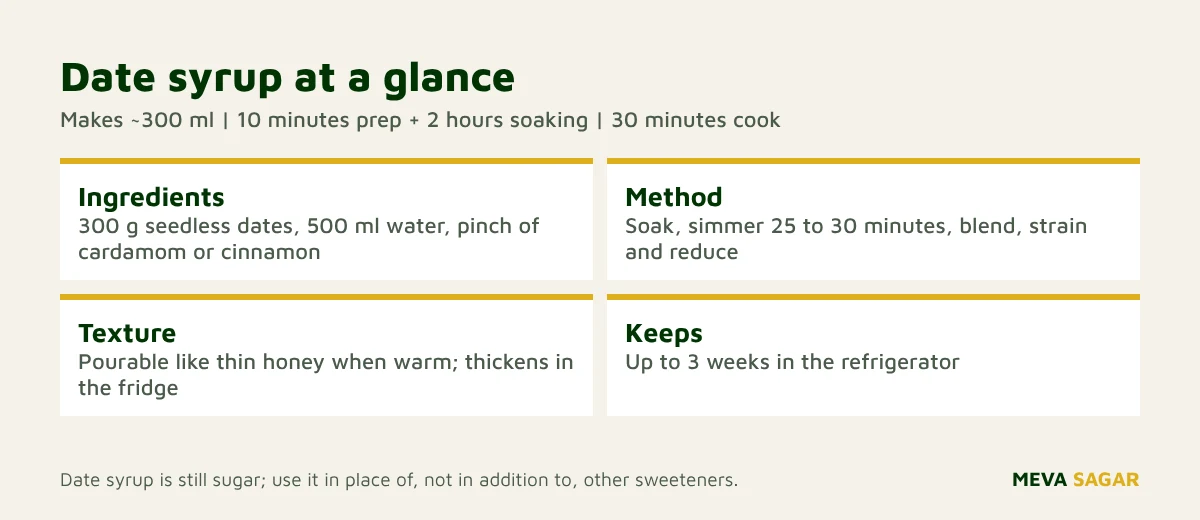
Quick answer: Soak 300 g seedless dates in 500 ml hot water for 2 hours. Simmer for 25 to 30 minutes, blend smooth, strain through a fine sieve or cloth, then simmer the liquid 10 to 15 minutes until it coats a spoon. Cool, bottle and refrigerate for up to 3 weeks. Makes about 300 ml. Use in place of other sweeteners.
Ingredients
| Ingredient | Quantity | Notes |
|---|---|---|
| Seedless dates | 300 g | Soft dates like Khalas or seedless dates |
| Water | 500 ml | Plus extra for adjusting |
| Cinnamon or cardamom | A pinch | Optional |
| Lemon juice | 1 tsp | Optional, helps keeping quality |
Method
- Soak
Chop dates and cover with 500 ml hot water. Soak for 2 hours until very soft. - Simmer
Bring to a boil, reduce heat and simmer for 25 to 30 minutes, stirring now and then, until dates fall apart. - Blend
Blend smooth in a blender, adding a little water if needed. - Strain
Pour through a fine sieve or muslin cloth, pressing to extract liquid. Discard or reuse the pulp. - Reduce
Return the liquid to a clean pan and simmer on low for 10 to 15 minutes until it coats a spoon. - Flavour
Add spices and lemon juice, then cool. - Bottle
Pour into a sterilised glass bottle or jar and refrigerate.
Check dates for insects and stems before soaking; see how to choose good dates.
Texture and consistency
| Cooking time after straining | Result | Use |
|---|---|---|
| 5 to 8 minutes | Thin, pourable | Smoothies, drinks, marinades |
| 10 to 15 minutes | Like thin honey | Pancakes, porridge, yoghurt |
| 20 minutes or more | Thick molasses | Baking, spreads, glazes |
Syrup thickens as it cools, so stop cooking when it is slightly thinner than you want.
How to use date syrup
- Drizzle over pancakes, porridge, oats and curd.
- Replace sugar in baking at a 1:1 ratio for liquid sweeteners, reducing other liquids slightly.
- Sweeten milkshakes and smoothies. See anjeer milkshake.
- Use in salad dressings and marinades.
- Replace jaggery in laddoos and chikki; see dry fruit chikki.
- Add to granola; see homemade granola.
Date syrup versus honey, jaggery and sugar
| Sweetener | Notes |
|---|---|
| Date syrup | Contains fibre traces, potassium and magnesium; caramel taste; still about 65 to 70 percent sugar |
| Honey | Similar sugars; floral taste |
| Jaggery | Unrefined cane sugar; small iron and minerals |
| White sugar | Pure sucrose, no nutrients |
No sweetener is a health food. The WHO recommends keeping free sugars, which include syrups and honey, below 10 percent of energy intake, and ideally below 5 percent. See USDA FoodData Central for composition. People with diabetes should check with their doctor; see dry fruits for diabetes.
Storage and shelf life
Store in a clean glass bottle in the refrigerator for up to 3 weeks. For longer storage, freeze in ice-cube trays and thaw as needed. Sterilise the bottle with boiling water. Discard if it smells fermented, bubbles or shows mould. Since the syrup has no preservatives, make small batches.
Troubleshooting
| Problem | Fix |
|---|---|
| Too thin | Simmer longer, remembering it thickens when cold |
| Too thick or crystallised | Warm gently with a spoon of water |
| Bitter taste | Scorched on the bottom; use lower heat and stir |
| Gritty | Strain through muslin cloth |
| Fermented smell | Make smaller batches and refrigerate promptly |
Kitchen notes
Date syrup is one of the oldest sweeteners in the world, used for thousands of years across the Middle East and North Africa, where it is called dibs or silan. Traditional production involves pressing dates and boiling the juice; the home method here is a gentler version. The flavour depends on the variety. Khalas and Kimia give a mild caramel taste, Mabroom gives a deeper, darker syrup, and Medjool makes a lush, toffee-like one. Mixing varieties can balance flavour.
Do not discard the pulp. It is full of fibre and flavour; stir it into porridge, add it to cake batter or blend it into energy balls. If you plan to use it, store in the refrigerator and use within two days.
Patience at the straining stage pays off. Pressing hard through a fine sieve gives a smoother syrup, while using a cloth gives a very clear one. If you want a rustic syrup, skip straining and use the blended mixture as a thick date paste for baking. Label your jars and note the date. For basic food safety guidance, see FSSAI.
Myths and common mistakes
| Myth or mistake | Reality |
|---|---|
| Date syrup is sugar free | It is natural sugar |
| It is safe to eat unlimited amounts | Treat as a sweetener |
| Boil on high heat to hurry | It scorches and turns bitter |
| It keeps for months at room temperature | Refrigerate and use within weeks |
| All dates give the same syrup | Variety changes taste and colour |
Using date syrup in everyday cooking
Date syrup is more than a pancake topping. Whisk it with lemon juice, olive oil and mustard for a sweet and sharp salad dressing, or brush it on roasted carrots and sweet potatoes in the last ten minutes of cooking for a glossy, caramelised finish. Stir a spoon into tea or coffee, blend it into lassi and shakes, or swirl it into yoghurt with a pinch of cardamom. In baking, replace sugar with an equal amount of syrup and reduce other liquid by about a quarter, and expect a slightly denser, darker crumb.
For traditional Indian sweets, date syrup can stand in for jaggery or sugar syrup in laddoos, halwa, kheer and panjiri; see panjiri recipe. Because it is less sweet than refined sugar by weight, you may need slightly more. Taste and adjust as you go, and remember that every sweetener counts toward your daily sugar intake.
Scaling the recipe and using a slow cooker
To double the batch, use a wider pot rather than a deeper one, since a wide surface evaporates the liquid faster. A slow cooker also works: cover dates with water, cook on low for four hours, blend, strain and then reduce on the stove. The slow method gives a deeper, more caramelised flavour.
If you plan to give date syrup as a gift, sterilise small glass bottles by boiling them for ten minutes, fill while the syrup is warm, cap tightly and refrigerate. Label with the date and advise the recipient to use it within three weeks. Do not store at room temperature, because the low acidity and moisture allow fermentation.
For people monitoring sugar, remember that a tablespoon of date syrup contains about 15 g of carbohydrate, similar to honey. Use it by the teaspoon rather than the tablespoon, and talk to your doctor if you have diabetes.
Frequently asked questions
How do I make date syrup at home?
Soak and simmer dates in water, blend, strain and reduce the liquid until it coats a spoon.
How long does homemade date syrup last?
Up to 3 weeks in the refrigerator, or 3 months frozen.
Is date syrup healthier than sugar?
It has a few more nutrients, but it is still sugar. Use it sparingly.
Can I use any dates?
Soft, seedless dates give the best result; remove seeds from others.
How can I use the leftover pulp?
Stir into porridge, cakes or energy balls.
Why is my syrup bitter?
It scorched. Use low heat and stir often.
The bottom line
Date syrup is easy: soak, simmer, blend, strain and reduce. Use it in place of refined sweeteners, in small amounts, and store it chilled for a rich, natural caramel flavour.


