
Walnuts look simple, but their pricing depends on a grading system that few shoppers know. Understanding walnut kernel grades helps you decide whether you really need pale, perfect halves, or whether broken pieces will do for your laddus and cakes. It also helps you avoid the biggest walnut problem in shops: kernels that are dark, bitter and stale. This guide explains the grades, the difference between imported and Kashmiri walnuts, and how to buy and store walnuts so that they taste sweet and buttery.
Quick answer: Walnut kernels are graded by colour (light, light amber, amber, dark) and by piece size (halves, quarters, pieces). Light halves cost the most and suit snacking and gifting. Broken pieces taste the same and are best for cooking. Kashmiri walnuts are a premium local variety. Choose light, dry, sweet-smelling kernels, and avoid dark or bitter ones.
How walnuts are graded
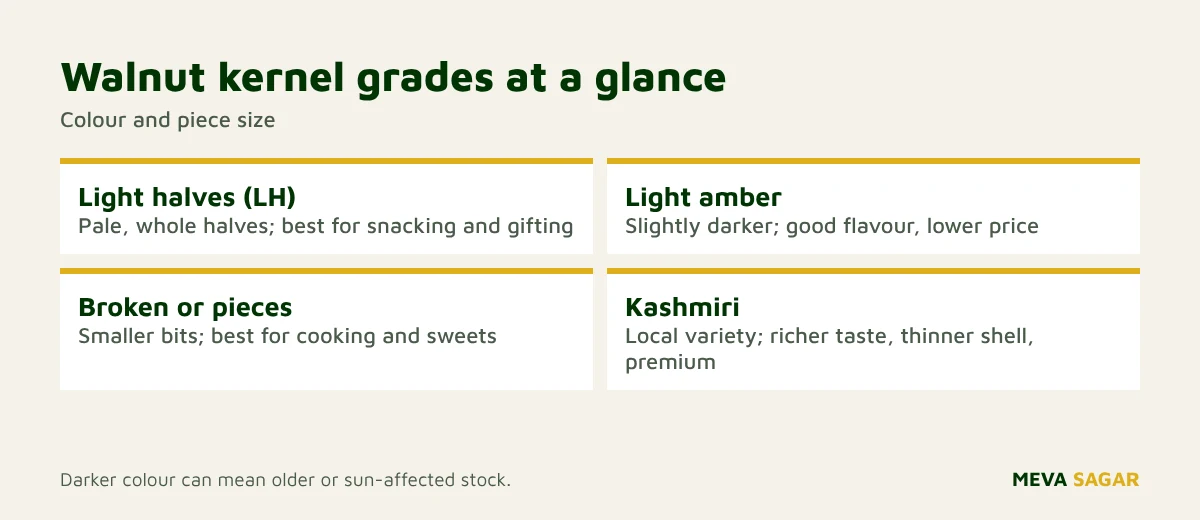
Walnut kernels follow trade standards used in the US and Europe, and Indian sellers use similar terms. Two things matter: colour and size.
| Grade | Colour | Piece size | Typical use |
|---|---|---|---|
| Light halves (LH) | Pale cream to light tan | Whole halves | Snacking, gifting, garnish |
| Light halves and pieces (LHP) | Light | Halves with some large pieces | Snacking, baking |
| Light amber | Light brown | Halves or pieces | Everyday eating, baking |
| Amber | Medium brown | Mostly pieces | Cooking, sweets |
| Broken (pieces) | Light to amber | Quarters, eighths, small bits | Cakes, laddus, halwa, stuffing |
| Kashmiri kernels | Light to golden | Halves and pieces | Premium eating, gifting |
Walnuts in shell are also available. See walnuts in shell. Browse the full walnuts range. Background on the nut is at walnut.
Does colour change nutrition?
Colour changes taste more than nutrition. Walnut skin is rich in polyphenols, and darker skin can be slightly more bitter. Kernels turn darker with age, heat and sun exposure, and dark, dull kernels may have started to oxidise. Per USDA FoodData Central, 30 g of walnuts (about 14 halves) gives roughly 185 kcal, 4.3 g of protein and 2.5 g of omega-3 ALA. Light and amber walnuts give similar figures. For benefits, read walnut benefits.
Kashmiri vs imported walnuts
| Feature | Kashmiri | Imported (California, Chile) |
|---|---|---|
| Shell | Thin, easy to crack | Thicker |
| Kernel | Often smaller, rich flavour | Large, uniform halves |
| Colour | Golden to light amber | Uniform light |
| Price | Premium | Moderate |
| Supply | Limited, seasonal | Large, steady |
| Best for | Special eating and gifting | Everyday use and cooking |
Jammu and Kashmir is India's main walnut region. Local walnuts are prized, but quality varies by crop and sorting, so buy from a trusted seller.
Which grade should you buy?
| If you are... | Choose | Why |
|---|---|---|
| Snacking daily | Light halves or light amber | Sweet and attractive |
| Baking cakes and brownies | Broken pieces | Same taste, lower cost |
| Making laddus and halwa | Broken pieces | Chopped anyway |
| Gifting | Light halves or Kashmiri | Presentation |
| Eating for omega-3 | Any fresh grade | Freshness matters most |
| Buying on a budget | Amber pieces, from fresh stock | Check taste before buying more |
Compare prices on the same weight and check the packing date. For help on pricing, see why dry fruits are expensive.
How to spot fresh walnuts
- Colour: pale to golden, not dark brown or grey.
- Smell: mild and sweet, with no paint-like or fishy note.
- Taste: buttery, with only a slight astringency from the skin; bitterness means rancid.
- Texture: crisp, not rubbery or soft.
- Packing: sealed, with date and FSSAI number.
- Weight (for in-shell walnuts): heavy for their size.
More checks are in our fresh dry fruit guide.
Storing walnuts
Walnuts are among the most perishable nuts, because of their high polyunsaturated fat. Kernels last only 2 to 4 months at room temperature in a cool, dry place, and 6 to 9 months in the fridge. Keep them airtight. Freeze if you buy in bulk. See how to store dry fruits for the full table and signs of rancidity, which is explained at rancidification.
Using walnuts well
- Toast for 5 minutes at 150 degrees Celsius to deepen flavour and remove some astringency.
- Soak for 4 to 6 hours if you find walnuts bitter. See soaking guide.
- Chop for salads, raita, parathas and cakes.
- Grind into a paste for sauces.
- Pair with dates, apples, honey, curd and dark chocolate.
Walnut oil and omega-3: a reminder
Walnuts have a higher share of polyunsaturated fat than most nuts, mainly linoleic acid (omega-6) and alpha-linolenic acid (omega-3). That is a health strength and a storage weakness: polyunsaturated oils oxidise easily. This is why the freshness of walnuts matters more than the grade. See omega-3 fatty acids for more background, and our heart health guide for how walnuts fit into a heart-friendly diet.
Walnut recipes by grade
| Recipe | Grade | Note |
|---|---|---|
| Walnut brownies or cake | Broken or amber pieces | Chop finely |
| Walnut and date energy balls | Broken pieces | See energy balls |
| Salad topping | Light halves | Toast lightly |
| Walnut chutney | Pieces | Blend with coriander and chilli |
| Stuffed dates | Light halves | Pair with Medjool |
Walnuts in shell
Walnuts in shell stay fresher for longer, because the shell protects the kernel. They are cheaper per kernel in some seasons, but you need to crack them and discard shells. A good in-shell walnut feels heavy for its size and does not rattle. A rattle means the kernel has dried out. Crack just before eating for the best flavour. If you are buying for gifting, in-shell walnuts look attractive in baskets.
Questions to ask your seller
- What is the crop year, and when was this lot packed?
- Where was it stored, and at what temperature?
- Is the grade light halves, light amber or mixed pieces?
- Can I taste one before buying?
- Is the pack sealed, with an FSSAI licence number?
- What is the return policy if the walnuts taste bitter?
A good seller will answer these without difficulty. If they cannot, consider shopping elsewhere.
Walnut allergy and safety
Walnut is among the more common tree nut allergens, and reactions can be serious. People with a tree nut allergy should avoid walnuts and check labels for cross-contact, especially in mixes. Walnut kernels may also carry mould if stored damp. Throw away any that look grey, fuzzy or smell musty. See tree nut allergy.
Walnut kernels in every grade
Light halves, broken pieces and Kashmiri walnuts, sealed fresh.
Frequently asked questions
What are light halves in walnuts?
Light halves are whole walnut halves with a pale colour. They are the premium grade, best for snacking, gifting and garnish.
Are broken walnuts as good as halves?
Yes in taste and nutrition. They are pieces of the same kernel, cheaper, and ideal for cooking and baking.
Why are my walnuts bitter?
Bitterness usually means they are old or rancid, or the skin is tannic. Soaking can reduce skin bitterness, but a paint-like taste means discard them.
Are Kashmiri walnuts better?
They are valued for their flavour and thin shell, but quality varies. They are a premium choice for eating and gifting.
How long do walnut kernels last?
Two to four months in a cool, dry place and six to nine months in the fridge. Keep them airtight.
Does darker walnut mean more antioxidants?
The skin has polyphenols, but darker kernels are often older and more bitter. Choose fresh, light to light amber walnuts.
How many walnuts should I eat per day?
About 5 to 7 halves (30 g). See our walnut benefits guide for details.
Can I roast walnuts?
Yes. Toast lightly at 150 degrees Celsius for about 5 minutes. Over-roasting makes them bitter.
The bottom line
Walnut grades mostly describe colour and piece size, and the right choice depends on what you are doing with them. Buy light halves for eating, broken pieces for cooking, check freshness by smell and taste and store them cold. Related reading: walnut benefits and why dry fruits are expensive.


