
For many Muslims, breaking the fast with dates is a cherished tradition during Ramadan, and for good reason: dates provide quick natural sugars, fibre, potassium and fluid-friendly sweetness after a long day without food or water. Choosing dates for Ramadan means thinking about variety, freshness, quantity and how to serve them. This guide covers which dates to buy, how many to eat at iftar and suhoor, serving ideas, how to pair dates with nuts and water, how to store a month's supply, and tips for people with diabetes or digestive issues, with respect for religious practice and medical advice.
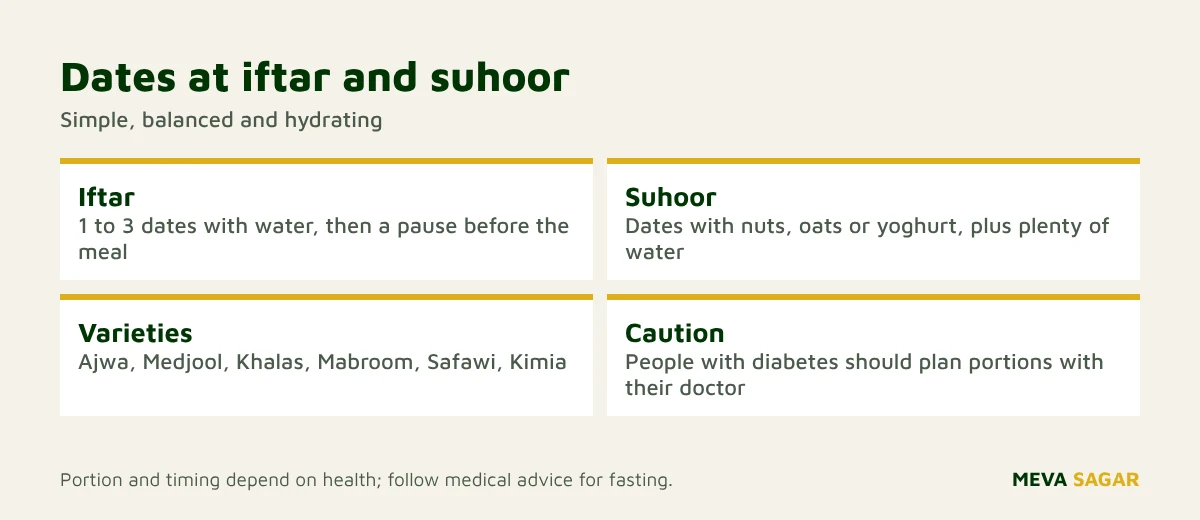
Quick answer: Break the fast with 1 to 3 dates and water, then pause before the main meal. Buy a mix: Ajwa and Medjool for special occasions, Khalas, Safawi, Mabroom and Kimia for daily use. Pair dates with nuts, yoghurt or oats at suhoor for slower-release energy. Store sealed and cool, or refrigerate. People with diabetes or other conditions should follow their doctor's advice on fasting and portions.
Why dates for iftar?
Dates are the traditional first food at iftar, following the practice of the Prophet Muhammad, who is reported to have broken his fast with fresh dates, or dried dates if fresh were unavailable, or water. Beyond tradition, there is a practical logic. After many hours without food, the body benefits from easily digested carbohydrate, and dates also provide potassium, magnesium and fibre, along with a small amount of water. See date palm and NIH on potassium. Nutrient values come from USDA FoodData Central.
Which dates to buy
| Variety | Character | Use at Ramadan |
|---|---|---|
| Ajwa | Small, dark, soft, mildly sweet | Special iftar; Ajwa dates |
| Medjool | Large, soft, caramel | Treat, stuffed dates; Medjool |
| Khalas | Soft, honeyed | Everyday iftar; Khalas |
| Mabroom | Long, chewy, dark | Premium daily; Mabroom |
| Safawi | Dark, soft, mellow | Everyday; Safawi |
| Kimia | Firm, mild | Cooking and desserts; Kimia |
See how to choose good dates and types of dates compared.
How many dates to eat
| Meal | Suggested dates | Notes |
|---|---|---|
| Iftar | 1 to 3 | With water, then pause, pray and eat the meal |
| Suhoor | 1 to 2 | With nuts, oats or yoghurt for slow energy |
| Snack between iftar and suhoor | 0 to 1 | Optional |
Total for the day usually stays within 3 to 6 dates for most adults. Dates are rich in sugar, so keep portions modest. See portion guide.
Serving ideas
- Plain dates with water or laban.
- Dates stuffed with almonds, walnuts or pistachios.
- Date and milk shake or smoothie.
- Dates with yoghurt and nuts at suhoor.
- Date-based sweets such as ma'amoul or date balls.
- Date syrup over oats; see date syrup recipe.
- Sheer khurma for Eid; see sheer khurma recipe.
A balanced iftar and suhoor
- Break the fast
1 to 3 dates and water. - Pause
Pray, then have soup or a salad. - Main meal
Protein, vegetables and whole grains; limit fried foods. - Hydrate
Water between iftar and suhoor, not only at once. - Suhoor
Complex carbohydrates, protein and a few dates with nuts for lasting energy.
Guidance on healthy eating is available from the WHO.
For people with diabetes and other conditions
People with diabetes should speak to their doctor before fasting and about how many dates are safe. Dates raise blood glucose, and pairing with nuts or yoghurt slows the rise. Those with kidney disease should check potassium limits. Pregnant and breastfeeding women, older adults and people on medicines should follow medical advice about fasting. See dry fruits for diabetes.
Storage for the month
Buy sealed packs close to Ramadan to ensure freshness, store in a cool dark place and refrigerate soft dates if the weather is warm. Keep boxes sealed and use clean, dry spoons. Check for mould, sourness or insects. See storage guide and insects in dry fruits.
Gifting dates at Ramadan and Eid
Sharing dates is a customary gesture of generosity. A box of Medjool or Ajwa with nuts makes a thoughtful gift for neighbours, relatives and colleagues. Choose sealed, labelled boxes and check for allergies. See dates and nuts gift box and corporate gifting.
Myths and common mistakes
| Myth or mistake | Reality |
|---|---|
| Eat as many dates as possible at iftar | A few is enough; balance with the meal |
| Dates alone are a complete meal | They are a starter, not a meal |
| Ajwa dates cure disease | They are nutritious; no medical cure |
| Dates are free for diabetics | Portions matter |
| Store dates anywhere | Keep them sealed and cool |
Why timing and variety matter in Ramadan
Over a month of fasting, routines matter more than any single food. Dates are a convenient anchor: they are easy to buy in bulk, require no cooking, keep for weeks and suit every age. Having more than one variety on the table keeps the month interesting. A common plan is to keep a premium variety such as Ajwa or Medjool for weekends and gatherings, and a good everyday variety such as Khalas, Safawi or Kimia for weekdays.
Fresh dates, when available, are softer and less sweet than fully dried dates, and some people prefer them at iftar. Rutab dates, which are partly ripe, appear in some markets in summer and are best eaten within days or refrigerated. Dried dates last far longer, which is why they are the main choice in India. Whichever you choose, taste before buying in bulk, because sweetness and texture differ widely.
Plan hydration along with dates. Water, laban, coconut water and milk all pair well with dates. Avoid very sugary drinks at iftar, which can cause a spike and crash. Eat slowly, and give your stomach a few minutes before the main meal. Dates are rich in fibre, so they also help digestion, which can be sluggish when meal times shift.
For families with children, stuff dates with a small almond half or a walnut piece, and make date shakes. For older adults, choose soft dates and chop them if chewing is difficult. Always check each date for insects or pits. For general guidance on healthy eating at festival times, see the WHO healthy diet advice, and for food safety, see FSSAI.
Dates beyond iftar: simple ideas through the month
Use dates in simple ways through Ramadan: blend into a shake with milk and almonds, chop into oats or porridge, mash into a spread with tahini or nut butter, or stuff with cream cheese and walnut for a quick dessert. A date and almond smoothie is a good suhoor drink, and a date and walnut cake can be baked ahead. See dates walnut cake recipe and date syrup recipe for ideas. Rotate varieties through the month so everyone enjoys the differences.
Frequently asked questions
How many dates should I eat at iftar?
Typically 1 to 3 with water, then pause before the main meal.
Which dates are best for Ramadan?
Ajwa and Medjool for special occasions, Khalas, Safawi, Mabroom and Kimia for daily use.
Can diabetics eat dates in Ramadan?
Only with medical guidance and small portions, paired with protein or fibre.
What should I eat with dates at suhoor?
Nuts, oats, yoghurt or milk for slow-release energy.
How do I store dates for the month?
Sealed, cool and dark; refrigerate soft dates in warm weather.
Are dates a good gift for Ramadan?
Yes, a box of good dates with nuts is a traditional and welcome gift.
The bottom line
Dates for Ramadan combine tradition and practical nutrition. Choose good varieties, eat a few with water at iftar, pair with nuts at suhoor, store carefully and follow medical advice where needed.