In South Indian kitchens, a spoonful of ghee-roasted cashews and raisins can make or break a festival sweet. In Tamil Nadu's Pongal celebrations and Kerala's Onam sadya, dry fruits for Pongal and Onam bring colour, crunch and richness to sakkarai pongal, payasam, pradhaman and more. This guide explains which dry fruits go into traditional sweets, how to roast them, what to buy and how much, how to choose quality cashews and raisins, how to make lighter versions with less sugar and jaggery, and how to store and gift festive treats, all with respect for regional variations.
Quick answer: For Pongal and Onam sweets, buy cashew splits or pieces, raisins, almonds, dates, cardamom, jaggery and good ghee. Roast cashews and raisins in ghee until golden and puffed, then stir into sakkarai pongal or payasam at the end. For a lighter dish, reduce jaggery, add dates, and use smaller portions. Use fresh cashews, store extras airtight and share sweets the same day.
Pongal and Onam in brief
Pongal is Tamil Nadu's four-day harvest festival, centred on cooking the first rice of the harvest in a pot until it boils over, symbolising abundance. Onam is Kerala's harvest festival, famous for its grand vegetarian feast (sadya) and payasam. Both festivals feature sweets sweetened with jaggery and finished with ghee, cashews and raisins. See Pongal and Onam. Although the dishes differ, the principle is the same: gather fresh rice, jaggery, ghee, coconut and dry fruits.
Dishes and the dry fruits they use
| Dish | Dry fruits | Notes |
|---|---|---|
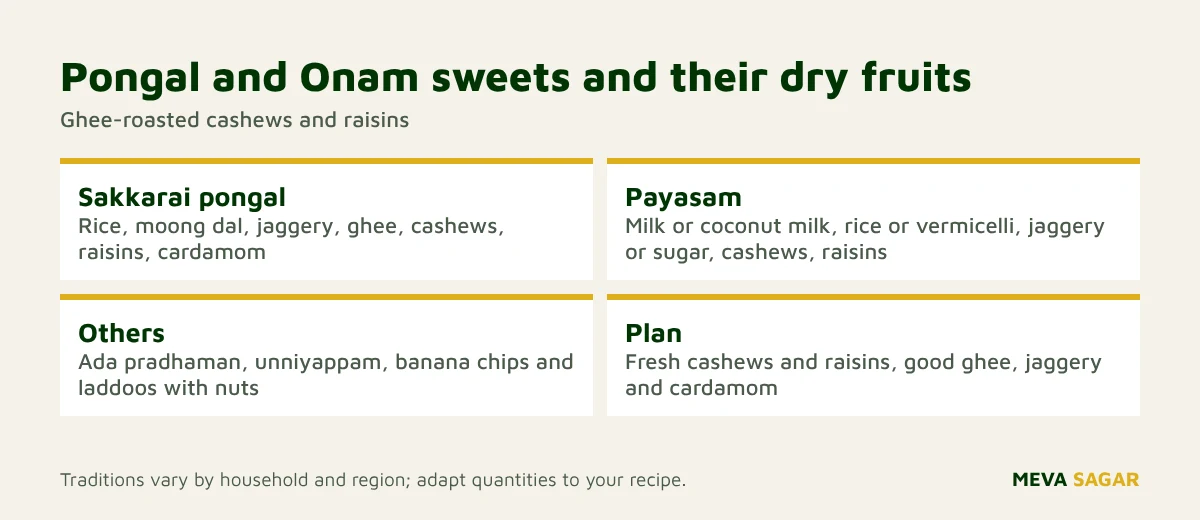
| Sakkarai pongal | Cashews, raisins, sometimes edible camphor and cardamom | Sweet rice and moong dal cooked with jaggery and ghee |
| Ven pongal (savoury) | Cashews, pepper, cumin | Savoury cousin, also with ghee-roasted cashews |
| Paal payasam | Cashews, raisins | Rice cooked slowly in milk |
| Ada pradhaman | Cashews, raisins, coconut slices | Rice flakes in coconut milk and jaggery |
| Semiya payasam | Cashews, raisins, sometimes almonds | Roasted vermicelli in milk |
| Unniyappam | Coconut bits, sesame, sometimes cashews | Banana and rice fritters |
| Laddoos | Cashews, almonds, dates | Festival sweets |
Find cashews at cashew splits and cashew pieces, and raisins at golden raisins and green raisins.
How to roast cashews and raisins in ghee
- Heat the ghee
Warm 2 tablespoons of ghee on low heat in a small pan. - Add cashews
Add 30 g chopped cashews and stir until light golden, about 1 to 2 minutes. - Add raisins
Add 20 g raisins; they puff up and turn plump in about 30 seconds. - Remove at once
Take off the heat immediately, as they burn easily. - Stir in
Add to the dish at the end with the ghee.
For better aroma, add a pinch of cardamom to the ghee. Use fresh cashews; see cashew types and how to tell if nuts are rancid.
How much to buy
| Purpose | Approximate quantity |
|---|---|
| Sakkarai pongal for 6 | 30 to 40 g cashews and 20 g raisins |
| Payasam for 8 | 40 g cashews and 25 g raisins |
| Full sadya sweets (3 dishes) | 150 g cashews, 100 g raisins, 50 g almonds |
| Guest snacks | 250 g mixed nuts and dates |
Plan the festival menu early and see festival planning for the approach.
Lighter festival sweets
- Reduce jaggery by 20 to 25 percent and add chopped dates for sweetness.
- Use less ghee for roasting, but do not skip it entirely; it provides flavour.
- Serve smaller portions, in cups instead of bowls.
- Use more nuts and fewer raisins if you want less sugar.
- For diabetics, ask a doctor and dietitian; see dry fruits for diabetes.
The WHO healthy diet guidance suggests moderate sugar; festival sweets are best enjoyed in small portions.
Freshness and storage
Sakkarai pongal and payasam are best eaten on the same day, though they can be refrigerated for a day. Store dry roasted cashews and raisins separately in airtight jars for a week at most. Keep raw nuts in the refrigerator in humid coastal weather. See dry fruits in monsoon and storage guide.
Gifting during Pongal and Onam
Families exchange sweets, fruits and dry fruit boxes during festival visits. A box of cashews, raisins and dates with a small jar of jaggery is a thoughtful gift. Add a banana leaf wrap for an Onam touch if you like. See gift ideas and almond and cashew duo box.
Kitchen notes
In South Indian cooking, ghee-roasted cashews and raisins are added at the end of cooking, and their flavour is as important as the sweetness of the dish itself. The roasting should be quick and gentle, with the ghee just warm enough to turn the cashews golden. If the ghee is too hot, the cashews brown on the outside and stay raw inside. If it is too cool, they absorb ghee and turn greasy. Watch the colour and stir constantly.
Jaggery adds a deep, caramel flavour but varies in sweetness and moisture. Melt it in a little water, strain out impurities and add it to the cooked rice or milk only after the grains are soft, because jaggery can prevent rice from softening further. Add cardamom and a pinch of dry ginger for warmth. Many families also add a tiny amount of edible camphor in temples; use only food-grade product, and sparingly.
Regional differences are a pleasure to explore. In Kerala, coconut milk and jaggery make rich pradhamans, while in Tamil Nadu, milk and rice make thick payasams. Cashews from Kerala and Tamil Nadu are prized, and many families still prefer the local nuts. Whichever you use, check freshness and label allergens before serving guests. For food safety guidance see FSSAI.
Myths and common mistakes
| Myth or mistake | Reality |
|---|---|
| Cashews must be fried until dark | Golden is enough; dark is bitter |
| Add raisins first | They burn quickly; add after cashews |
| Jaggery and sugar are interchangeable | Jaggery adds flavour and moisture |
| Festival sweets keep for days | Cook and eat fresh |
| All raisins are the same | Choose plump, soft ones |
A sample festival menu with dry fruits
For Pongal, a simple menu might include ven pongal with ghee-roasted cashews and pepper for breakfast, sakkarai pongal as the main sweet, a vegetable sambar, rice, vadai and a platter of sugarcane, banana and dry fruits. For Onam, the sadya includes dozens of dishes on a banana leaf, ending with two or three payasams. Cashews, raisins, coconut slices and sometimes almonds appear in the payasams.
To keep the workload manageable, prepare cashews and raisins for all dishes at once. Fry a large batch of cashews and raisins in ghee in the morning, cool them and keep them in a covered bowl. Spoon them into each dish just before serving. Chop dates and almonds the day before. This approach ensures even quality across dishes and saves time on the festival morning.
When you cook for many guests, taste frequently, keep sweetness moderate and offer a few savoury items alongside. Provide small tasting portions so that guests can try everything. For guests with diabetes or on low-sugar diets, offer fruit and plain nuts. For those with allergies, label dishes with cashews, almonds, milk and coconut. See WHO healthy diet advice for balancing festive meals.
Frequently asked questions
Which dry fruits go into sakkarai pongal?
Cashews and raisins roasted in ghee, with cardamom.
What dry fruits are used in Onam payasam?
Cashews and raisins, often with coconut slices or almonds.
How do I roast cashews and raisins?
In warm ghee on low heat until the cashews are golden and the raisins puff, for about two minutes.
Can I reduce sugar in payasam?
Yes, use less jaggery and add dates.
How long does sakkarai pongal last?
Best the same day; refrigerate for a day.
Which cashews are best for festival sweets?
Splits or pieces are good for cooking, while whole W240 look best for garnish.
The bottom line
Dry fruits for Pongal and Onam finish the sweets: ghee-roasted cashews and raisins. Buy fresh, roast gently, add at the end, reduce sugar where possible and share the sweets the same day.