

Families that eat dry fruits daily often find that bulk buying dry fruits saves money and avoids last-minute shopping. But bulk also brings risk: nuts can turn rancid, dates can harden or ferment, raisins can clump and insects can invade. The key is to buy the right quantity, choose items that store well, split the stock into portions and use sensible storage. This guide shows how to estimate your monthly need, gives a sample list for a family of four, explains what to buy monthly versus quarterly, and shares storage and rotation rules that keep stock fresh to the last handful.
Quick answer: Estimate about 30 g of nuts and a small handful of dried fruit per person per day. For four people that is roughly 3.6 kg of nuts and 1.5 kg of dried fruit a month at most; many families need less. Buy hardy items (raisins, dates, almonds) in bulk and delicate ones (walnuts, cashews, pistachios) in smaller batches. Store airtight, cool and dark, refrigerate or freeze extra, and use the first-in first-out rule.
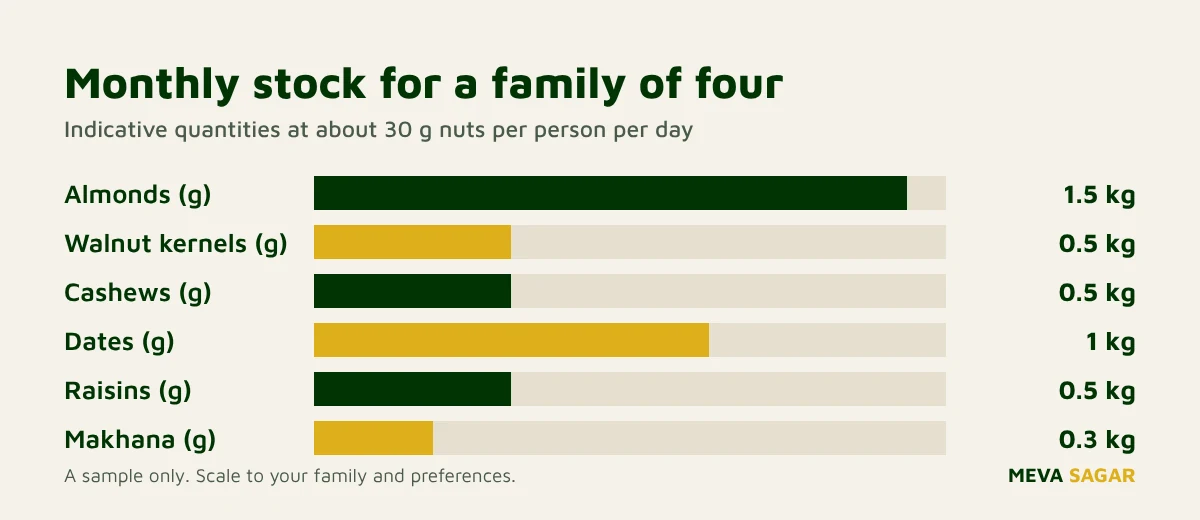
Estimate your monthly need
Start with the daily portion guide: about 30 g of nuts and a small handful of dried fruit per adult, less for children. Multiply by the number of people and 30 days. For four people eating 30 g of nuts daily, the maximum is 3.6 kg a month, but most households eat less because not every person eats every day. Track your actual consumption for one month, then adjust. See how many dry fruits per day.
A sample monthly list for four
| Item | Monthly quantity | Notes |
|---|---|---|
| Almonds | 1 to 1.5 kg | Everyday nut. See California almonds |
| Walnut kernels | 0.5 kg | Keep cool. See walnut kernels |
| Cashews | 0.5 kg | Whole or splits. See cashews W240 |
| Pistachios | 0.25 to 0.5 kg | Treat or snack |
| Dates | 1 kg | See Khalas dates |
| Raisins | 0.5 kg | See black raisins |
| Makhana | 0.3 kg | See makhana |
These quantities suit a moderate eater. Increase for athletes and teens, reduce for weight loss.
Which items suit bulk buying?
| Item | Bulk friendly? | Why |
|---|---|---|
| Raisins | Yes | Low moisture, stable |
| Dates (dry and firm types) | Yes | Store in a cool place |
| Almonds | Yes, 1 to 3 months | Moderate fat, good shelf life |
| Walnuts | Smaller lots | High omega-3 fat turns rancid faster |
| Cashews | Smaller lots | Prone to rancidity in heat |
| Pistachios | Moderate | Keep sealed |
| Makhana | Smaller lots | Absorbs moisture and goes soft |
| Dried mango and soft fruit | Small lots | Sticky and mouldy in humidity |
See dry fruit shelf life for more.
Savings: how much and where
Buying a larger pack lowers per-kg cost, since packaging and handling costs are spread. Savings of 5 to 15 percent are common between small and large packs, but this depends on the seller. Also watch for seasonal dips and pre-festival offers, though prices often rise before festivals. Buy to your storage capacity, not to the biggest discount, since wasted stock erases savings. See dry fruits price per kg.
Storage setup for bulk stock
- Split the stock
Keep a small working jar for daily use and store the rest sealed. - Use airtight containers
Glass or steel with tight lids; keep out of sunlight. - Refrigerate or freeze extra
Nuts keep for months in zip bags with air pressed out. Let them come to room temperature before opening to avoid condensation. - Add labels
Write the date of purchase on each container. - Use dry spoons
Moisture invites mould. - Rotate
First in, first out.
In monsoon, check stock weekly. See dry fruits in monsoon.
Checking stock quality
- Smell for sourness or paint-like notes.
- Look for white powder (sugar bloom on dates is harmless, mould is not), webbing, holes and tiny insects.
- Taste one nut from each batch weekly.
- Discard anything off. See how to tell if nuts are rancid and insects in dry fruits.
Monthly versus quarterly shopping
A practical split is to buy raisins, dates and almonds every two to three months, and walnuts, cashews and makhana every month. Buy dried fruits for festive use close to the date. If your home is hot or humid, buy smaller and more often. A refrigerator or deep freeze changes this and lets you buy more at once.
Mistakes to avoid
| Mistake | Fix |
|---|---|
| Buying more than you can store | Plan by weighing monthly use |
| Leaving the big pack open | Decant to small jars |
| Storing next to the stove or in sunlight | Use a cool shelf |
| Mixing old and new nuts | Finish the old stock first |
| Ignoring labels | Note best-before dates |
Myths and common myths about bulk
| Myth | Reality |
|---|---|
| Bulk is always cheaper | Only if you use it before it spoils |
| Dry fruits never go bad | They go rancid or mouldy |
| Freezing ruins nuts | Properly sealed freezing preserves them |
| Refrigerating dates is harmful | It prolongs shelf life |
| Big containers are fine | Use small working jars to limit air exposure |
A step-by-step first bulk order
If you have never bought in bulk, start modestly. In month one, buy double your normal quantity of almonds, dates and raisins, and store them as described. Check them weekly and note any change. In month two, add walnuts and cashews in their normal quantities, and put half in the refrigerator. By month three you will know your real consumption and how your kitchen and climate treat nuts, and can set a stable monthly order.
Share bulk orders with relatives or neighbours if your family is small. Splitting a 5 kg order among three households gives bulk pricing without any single family holding stock for too long. Agree on a day to pack and divide the nuts into clean, dry containers. For hygiene, use clean dry hands or spoons and sealed bags.
Finally, check official guidance on food storage and labels from FSSAI, and the general eating advice from the WHO, to make sure your stock plan fits a balanced diet rather than simply a bigger pantry.
Keeping a simple stock register
A small notebook or phone note listing item, quantity, purchase date and storage place takes two minutes a month and prevents forgotten packets. Tick items off as you open them and mark any that smell odd. Review it on the first of each month before ordering, and you will almost never run out or throw away old stock.
Families with children can make it a small routine: let kids help fill the weekly snack jars and learn to smell and check nuts, which builds good food habits early.
Family packs, sealed fresh
Almonds, dates, raisins and mixes in 500 g and 1 kg packs.
Frequently asked questions
How many dry fruits does a family need per month?
At most about 30 g of nuts and a small handful of dried fruit per adult per day; many families use less. Track one month and adjust.
Which dry fruits are best to buy in bulk?
Raisins, dates and almonds store best. Buy walnuts, cashews and makhana in smaller lots.
How long can I store bulk dry fruits?
Months, if sealed airtight, kept cool and dark, and refrigerated or frozen for the extra stock.
Is bulk buying cheaper?
Per kg often yes, but only if you finish it before it spoils.
Can I freeze nuts?
Yes. Use airtight bags, remove air and bring to room temperature before opening.
How do I stop insects in dry fruits?
Use airtight containers, keep stock cool and dry, and inspect weekly.
The bottom line
Bulk buying dry fruits works when you estimate your real need, choose hardy items, divide stock into working jars and a protected reserve, label dates and rotate. A small plan turns savings into fresh, daily-ready nuts rather than waste.