
If you are building a vegetarian or high-protein diet, you will often hear that nuts are a good source. The numbers explain why, but also why expectations should be realistic. Protein in almonds is about 21 g per 100 g, which is high for a plant food, but a typical handful of 30 g gives only about 6 g. That is useful, not enough on its own. This guide lists protein per 100 g and per serving for the common nuts, compares them with dal, eggs, paneer and curd, explains protein quality, and shows how to combine nuts with other foods so your snacks and meals reach your daily target.
Quick answer: Almonds have about 21 g of protein per 100 g (roughly 6 g per 30 g handful), pistachios 20 g, cashews 18 g and walnuts 15 g. Nuts are a helpful plant protein, but a single portion supplies only 5 to 6 g, so pair them with dal, curd, paneer, eggs or soy to meet higher needs.
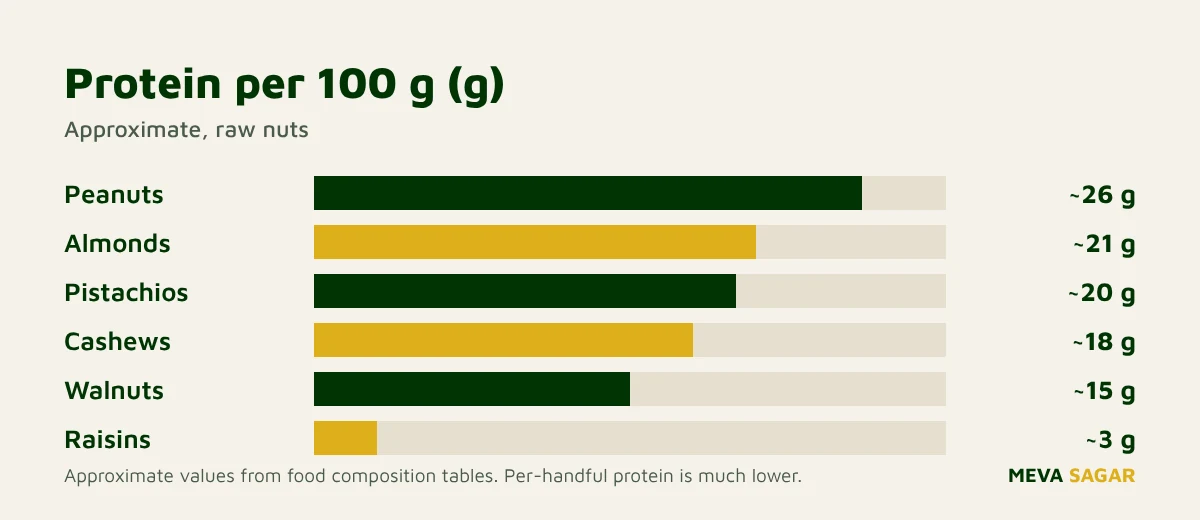
Protein per 100 g and per serving
| Nut or dried fruit | Per 100 g | Per 30 g handful | Calories per 30 g |
|---|---|---|---|
| Peanuts | ~26 g | ~7.8 g | ~170 |
| Almonds | ~21 g | ~6.3 g | ~173 |
| Pistachios | ~20 g | ~6 g | ~168 |
| Cashews | ~18 g | ~5.5 g | ~166 |
| Hazelnuts | ~15 g | ~4.5 g | ~188 |
| Walnuts | ~15 g | ~4.5 g | ~196 |
| Brazil nuts | ~14 g | ~4.2 g | ~197 |
| Makhana (roasted) | ~10 g | ~3 g | ~100 |
| Raisins | ~3 g | ~1 g | ~90 |
Values are approximate and come from standard tables such as USDA FoodData Central and the National Institute of Nutrition. Exact numbers vary by variety and moisture.
How much protein do you need
The recommended intake for healthy adults is roughly 0.8 g of protein per kg of body weight a day, so a 60 kg adult needs about 48 g. People who train hard, older adults and some medical groups may need more, around 1.2 to 1.6 g per kg. A 30 g handful of almonds covers about 12 percent of a 50 g target. That is a useful contribution, but not a substitute for main protein sources. For a broader plan see high protein dry fruits and nuts. See also protein for background on its role in the body.
Nuts compared with other protein foods
| Food | Serving | Protein | Calories |
|---|---|---|---|
| Almonds | 30 g | ~6 g | ~173 |
| Boiled egg | 1 large | ~6 g | ~78 |
| Dal (cooked) | 1 cup | ~9 g | ~230 |
| Paneer | 50 g | ~9 g | ~140 |
| Curd (plain) | 1 cup | ~8 g | ~150 |
| Soy chunks (dry) | 30 g | ~15 g | ~100 |
| Chicken breast | 100 g | ~31 g | ~165 |
Nuts bring protein plus fibre and healthy fat, but they are less protein-dense per calorie than eggs, paneer, soy or lean meat. Use them as an add-on, not the base of your protein plan.
Protein quality: are nuts complete proteins?
Protein quality depends on the amino acids a food provides. Most nuts are low in lysine, an essential amino acid, and so are not "complete" on their own. This is not a problem in a mixed diet: pulses, dal, curd, milk and soy are rich in lysine and complement nuts well. Eating dal with rice and a handful of nuts across the day gives the body what it needs. For vegetarians, combining different plant proteins through the day is enough, and they do not need to be eaten in the same meal.
Almonds, cashews and walnuts: which is best for protein
Almonds win among popular tree nuts, with about 6 g per 30 g, followed closely by pistachios and cashews. Walnuts are lower in protein but higher in omega-3. Peanuts, which are legumes, have the most protein of all, but they have different allergen and aflatoxin considerations. If protein is your main goal, almonds are a practical choice, and their fibre and vitamin E are a bonus. See walnuts vs almonds, cashew vs almond and pistachios vs almonds.
How to build a 15 g protein snack
- Nuts
30 g almonds or pistachios gives about 6 g. - Curd
A cup of plain curd adds about 8 g. - Seeds
A tablespoon of pumpkin seeds adds about 3 g. - Combine
Mix nuts and seeds into curd with fruit. - Total
About 17 g protein for roughly 330 calories.
Other ideas: a boiled egg with 10 almonds, paneer cubes with walnuts, or sprouts chaat topped with chopped cashews.
Protein ideas for vegetarians and vegans
- Add chopped almonds to oats cooked with milk or soy milk.
- Blend soaked cashews into gravies for creaminess and protein.
- Sprinkle walnuts and pumpkin seeds over salads.
- Combine nuts with chana or rajma chaat.
- Use almond or cashew butter with whole-grain toast.
- Add makhana to curd or chaat for crunch.
See dry fruits for vegans and vegetarians for a complete plan.
Protein, calories and weight goals
Nuts are energy dense, so relying on them alone for protein can add many calories. For example, getting 20 g of protein from almonds would need about 95 g and nearly 550 calories, whereas the same protein from paneer or eggs costs far fewer calories. If you are losing weight, use nuts for fibre, healthy fat and satisfaction, and get most protein from leaner sources. If you are gaining weight or have a small appetite, nuts are a useful way to add calories and some protein together. See dry fruits for weight gain.
Roasted, soaked and butter forms
Roasting changes protein very little. Soaking may improve digestibility for some people but does not increase protein. Nut butters, such as almond butter, have about 20 to 21 g of protein per 100 g, which is about 3.5 g per tablespoon, but they are calorie dense, and commercial brands may add sugar and oil. Choose butters with only nuts on the ingredient list. Flavoured nuts may have coatings that dilute protein per gram. See raw vs roasted vs salted nuts.
Buying nuts for protein
Choose fresh, sealed packs and check the date. Whole kernels give more protein per rupee than flavoured mixes with sugar coatings. California almonds and pistachio kernels are popular for high-protein snacking, while cashews add creaminess. Store them airtight so they stay fresh; see how to store almonds, cashews and walnuts.
Reading labels on nut products
Packaged nut snacks often list protein per 100 g, which can look impressive, but your portion is a fraction of that. Check the serving size, because a 25 g pack gives about 5 g of protein, not 20 g. Flavoured, coated or sugar-glazed nuts have lower protein per gram because the coating adds weight. Mixed snack packs that include fried gram, puffed rice or dried fruit also dilute protein. Compare products by protein per serving and per 100 calories, and choose plain nuts when protein is the goal.
Frequently asked questions
How much protein is in almonds?
About 21 g per 100 g, or roughly 6 g in a 30 g handful.
Which nut has the most protein?
Peanuts have the most, followed by almonds, pistachios and cashews.
Can I meet my protein needs with nuts alone?
Not practically, because nuts are calorie dense. Combine them with dal, curd, paneer, eggs or soy.
Are nuts complete proteins?
Most are low in lysine, but a varied diet with pulses and dairy fills the gap.
Is almond butter high in protein?
It has about 3.5 g per tablespoon, but also many calories, so use it in small amounts.
Do roasted nuts have less protein?
No, roasting changes protein very little.
The bottom line
Protein in almonds and other nuts is helpful but modest per serving. Use nuts for fibre, healthy fats and a protein boost, and rely on dal, curd, paneer, eggs or soy for the bulk of your daily protein.


