

Anyone who has had a kidney stone is likely to hear the advice to watch oxalate, and almonds often appear on the list. Oxalates in almonds are indeed relatively high compared with other nuts, and most kidney stones are calcium oxalate. That does not mean everyone must avoid almonds. For most healthy people, a small handful is fine, and the bigger levers for stone prevention are fluids, calcium intake and salt. This guide explains what oxalate is, how much common nuts contain, who needs to be careful, how to eat nuts safely if you are stone-prone and what else you can do to lower risk.
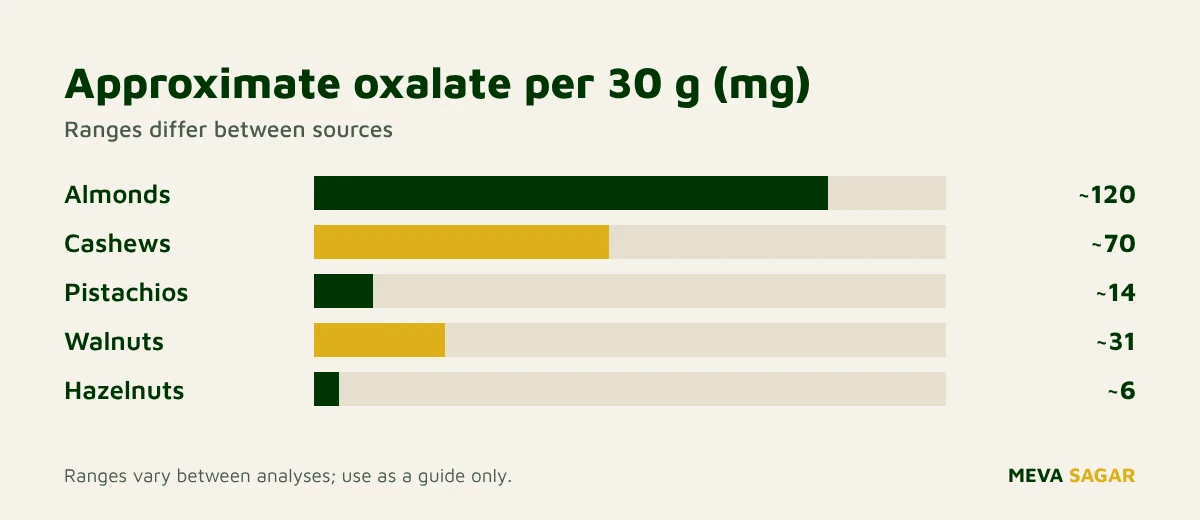
Quick answer: A 30 g portion of almonds contains roughly 100 to 130 mg of oxalate, which is high for a snack. People with a history of calcium oxalate kidney stones are often advised to limit high-oxalate foods, drink plenty of water and eat enough calcium with meals. Most others can eat a handful of nuts daily. Lower-oxalate choices include hazelnuts, pistachios and walnuts.
What oxalate is and why it matters
Oxalate is a natural compound found in many plant foods, including spinach, beetroot, rhubarb, tea, chocolate and nuts. In the gut, it can bind calcium. Oxalate that is not bound passes into the blood and is excreted by the kidneys, where it can combine with calcium to form crystals. About 70 to 80 percent of kidney stones are calcium oxalate. See oxalate and kidney stone disease for background. Most of the oxalate in urine is made by the body, and diet contributes the rest, so food choices are only one part of risk.
Oxalate content of nuts and dried fruit
| Food (30 g) | Oxalate (mg, approx) | Rating |
|---|---|---|
| Almonds | 100 to 130 | High |
| Cashews | 50 to 90 | Moderate to high |
| Peanuts | 40 to 80 | Moderate |
| Walnuts | 25 to 40 | Low to moderate |
| Pistachios | 10 to 20 | Low |
| Hazelnuts | 5 to 15 | Low |
| Raisins | 15 to 25 | Low to moderate |
| Dried figs | ~25 | Low to moderate |
| Dates | ~5 | Low |
Published values vary by source and method. Many clinicians use less than 100 mg per day as a low-oxalate target, and some use 40 to 50 mg for people with high urinary oxalate.
Who needs to be careful
- People with a history of calcium oxalate kidney stones.
- Those with high urinary oxalate on a 24-hour urine test.
- People with certain bowel conditions or past bowel surgery that increase oxalate absorption.
- Anyone advised by a doctor or dietitian to follow a low-oxalate diet.
For people without these risks, nuts in normal portions are not a concern. See dry fruits for kidney disease for other kidney considerations.
Safe portions for stone-prone people
If you have had stones, do not assume you must stop nuts entirely. A small portion of 10 to 15 g of almonds adds roughly 40 to 60 mg of oxalate, which may fit within a daily budget if the rest of your diet is moderate. Alternatively, choose lower-oxalate nuts such as hazelnuts, pistachios and walnuts. Spread nuts through the week, avoid combining high-oxalate foods in one meal, and ask your doctor or dietitian for a personalised limit. A 24-hour urine test can show whether oxalate is actually a problem for you.
How to lower stone risk without cutting nuts
- Drink enough fluid
Aim for urine output of 2 to 2.5 litres a day, which usually means 2.5 to 3 litres of fluid. - Eat calcium with meals
Dairy or calcium-rich foods bind oxalate in the gut so less is absorbed. - Limit salt
High sodium increases urinary calcium. - Moderate animal protein
Large amounts raise stone risk. - Add citrate
Lemon water or citrus fruit can raise urinary citrate. - Keep a healthy weight
Obesity raises risk.
These steps usually matter more than the occasional almond. See the NIH calcium fact sheet for calcium guidance.
Pairing nuts with calcium
Because oxalate binds calcium in the gut, eating almonds with a calcium source can reduce the oxalate that is absorbed. Examples include almonds with curd or a glass of milk, or nuts added to a paneer dish. This is why current advice generally does not recommend restricting dietary calcium for stone-formers. Calcium supplements are different: they are best taken with meals and only on the advice of a doctor. The pairing approach is easy and does not require giving up foods you enjoy.
Soaking, roasting and almond products
Soaking nuts is sometimes suggested for oxalate, but studies show only a small reduction, and the soaking water may carry some of it away. Roasting has little effect. Almond flour and almond milk concentrate the oxalate from many almonds into a small portion, so a glass of almond milk or a serving of almond flour can contain more than you expect. If you are limiting oxalate, count these products as nuts. See almond milk at home for how many nuts go into a glass.
Other high-oxalate foods to keep in perspective
| Food | Oxalate level |
|---|---|
| Spinach | Very high |
| Beetroot | High |
| Rhubarb | Very high |
| Black tea | Moderate to high |
| Dark chocolate and cocoa | Moderate to high |
| Sweet potato | Moderate |
| Wheat bran | High |
If you have stones, check the whole day, not only nuts. Often a few big sources, such as spinach smoothies or many cups of tea, contribute far more than a handful of almonds.
When to talk to a doctor
If you have had a stone, ask your urologist or nephrologist whether a 24-hour urine test is appropriate, and request a referral to a registered dietitian. Seek urgent care for severe flank pain, fever with pain, blood in urine or inability to pass urine. For general diet guidance, see the WHO healthy diet page. See almonds and pistachios if you are looking for alternatives with different oxalate levels.
Reading your results and setting a personal limit
If a 24-hour urine test shows high oxalate or low citrate, your clinician may suggest a specific plan. This could include a daily oxalate target, a fluid goal and a calcium schedule. Keep a food diary for a week, listing nuts, leafy greens, tea and chocolate, and bring it to your dietitian. Together you can decide whether to keep almonds, reduce them to a few pieces or swap to lower-oxalate nuts. Re-test after a few months if your doctor advises, to see whether changes are working.
Almonds in children and older adults
Children who have had stones, or who have a family history, should follow medical advice about nuts. Older adults often have lower fluid intake and may be on medicines that affect the kidney, so hydration is especially important. For both groups, soft forms such as ground almonds in a porridge, rather than a large handful, make portions easier to control and reduce choking risk. Always include a calcium source such as milk or curd with the meal.
Frequently asked questions
Are almonds high in oxalate?
Yes, roughly 100 to 130 mg per 30 g, which is higher than most other nuts.
Can I eat almonds if I have kidney stones?
Often in small portions, with enough fluids and calcium, but check with your doctor or dietitian.
Which nuts are lowest in oxalate?
Hazelnuts and pistachios are low, with walnuts low to moderate.
Does soaking almonds reduce oxalate?
Only slightly. Fluids and calcium pairing matter more.
Is almond milk high in oxalate?
It can be, because it concentrates many almonds. Count it as a nut serving.
Should everyone avoid oxalate?
No. Only people at risk of kidney stones or with specific medical advice need to limit it.
The bottom line
Oxalates in almonds are relatively high, but most people can enjoy nuts safely. If you are stone-prone, keep portions small, favour lower-oxalate nuts, drink plenty of water, eat calcium with meals and ask your doctor for a personalised plan.


