
Nuts are 45 to 75 percent fat, which surprises people who have been told to avoid fat. The truth is that healthy fats in nuts are mostly unsaturated, the type associated with better cholesterol and lower heart risk when they replace saturated fat. But not all nuts have the same profile: almonds and hazelnuts lean monounsaturated, walnuts are rich in polyunsaturated fat and plant omega-3, and Brazil nuts and macadamias contain more saturated fat. This guide explains the fat types in plain language, shows which nuts are richest in each, describes how fats affect the heart and gives practical portion advice.
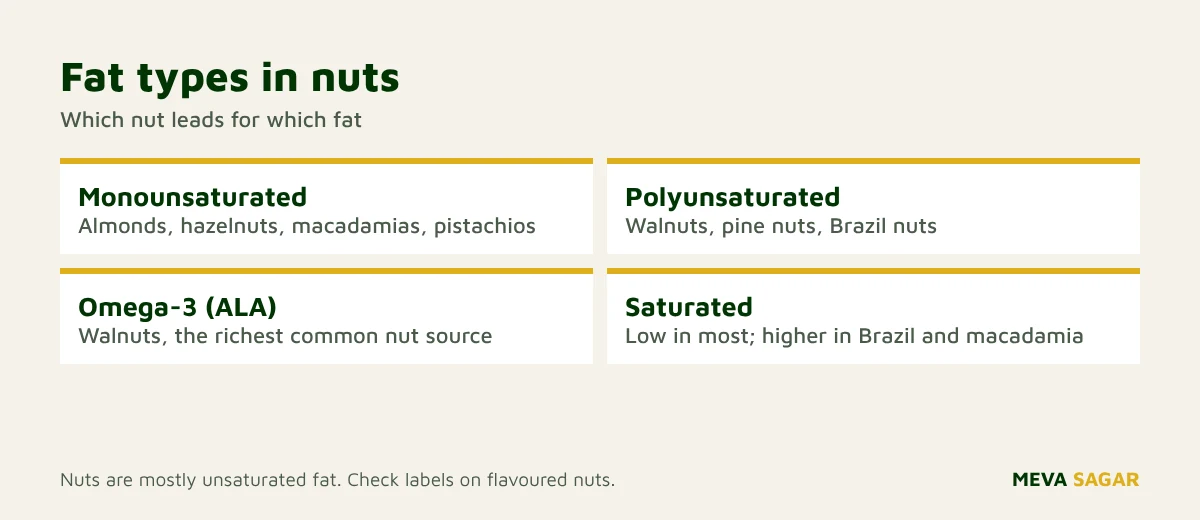
Quick answer: Most fat in nuts is unsaturated. Almonds, hazelnuts, pistachios and macadamias are rich in monounsaturated fat, walnuts are rich in polyunsaturated fat including plant omega-3 (ALA), and cashews are balanced. Saturated fat is low in most nuts. A 30 g portion a day, replacing fried or processed snacks, supports heart health, but calories still count.
The three types of fat
Dietary fat comes in three main types. Saturated fats are found in butter, ghee, coconut oil and fatty meat, and they raise LDL cholesterol when eaten in excess. Monounsaturated fats, found in olive oil, almonds and groundnut oil, help lower LDL when they replace saturated fat. Polyunsaturated fats include omega-6 and omega-3 types and are essential, meaning the body cannot make them. Nuts mostly supply the second and third types. See unsaturated fat, monounsaturated fat and omega-3 fatty acids for background.
Fat profile of common nuts
| Nut (30 g) | Total fat | Mono | Poly | Saturated |
|---|---|---|---|---|
| Almonds | ~15 g | ~9.5 g | ~3.8 g | ~1.1 g |
| Cashews | ~13 g | ~7 g | ~2.2 g | ~2.6 g |
| Walnuts | ~19 g | ~2.5 g | ~13.5 g | ~1.7 g |
| Pistachios | ~13 g | ~6.8 g | ~4 g | ~1.6 g |
| Hazelnuts | ~18 g | ~13.5 g | ~2.2 g | ~1.3 g |
| Macadamias | ~21 g | ~16.5 g | ~0.5 g | ~3.4 g |
| Brazil nuts | ~20 g | ~7 g | ~7 g | ~4.6 g |
Values are approximate, from USDA FoodData Central. Individual lots differ.
Why unsaturated fat helps the heart
Replacing saturated fat with unsaturated fat lowers LDL cholesterol, and many trials show that eating nuts daily reduces LDL by a small but meaningful amount. Nuts also supply fibre, plant sterols, magnesium and antioxidants, which add to the effect. Large cohort studies link regular nut eating to lower rates of heart disease. The WHO healthy diet guidance recommends that unsaturated fats replace saturated and trans fats. See dry fruits for heart health for how to apply this.
Walnuts and plant omega-3
Walnuts are the richest common nut source of alpha-linolenic acid (ALA), a plant omega-3. A 30 g portion provides about 2.5 g of ALA, which exceeds the adequate daily intake for most adults. The body converts a small share of ALA into EPA and DHA, the omega-3s found in fish. For vegetarians, walnuts, flaxseed and chia are the main plant sources. See omega-3 nuts and vegetarian alternatives and benefits of walnuts.
Almonds, hazelnuts and monounsaturated fat
Almonds, hazelnuts, pistachios and macadamias are high in monounsaturated fat, the same type that makes olive oil a staple of the Mediterranean diet. These nuts also have vitamin E, which acts as an antioxidant in cell membranes. Almonds in particular have been studied for LDL lowering and for fullness. If you want a single everyday nut, almonds are a reliable choice. See vitamin E rich dry fruits and hazelnuts.
Saturated fat in nuts: how much to worry
Most nuts are low in saturated fat, around 1 to 2 g per 30 g. Cashews, Brazil nuts and macadamias are a little higher at 2.5 to 4.5 g. These amounts are small compared with a spoon of ghee, which has about 8 g, or a typical biscuit with palm oil. In context, a handful of these nuts does not meaningfully raise saturated fat intake. Large portions would, though, and coconut is much higher than tree nuts. The overall pattern of your diet matters more than any single nut.
Calories: the catch
| Portion | Calories | Equivalent to |
|---|---|---|
| 30 g almonds | ~173 | A small samosa |
| 30 g walnuts | ~196 | Two biscuits plus a tea |
| 30 g cashews | ~166 | A slice of cake |
| 60 g mixed nuts | ~350 | A small meal |
Fat is 9 calories per gram, so nuts add up quickly. Use the portions in how many dry fruits per day and swap nuts for less healthy snacks, not on top of them.
Choosing nuts to match your goal
- Heart health: walnuts and almonds daily.
- Omega-3 for vegetarians: walnuts, plus flaxseed.
- Vitamin E: almonds and hazelnuts.
- Lower saturated fat: almonds, pistachios and walnuts.
- Selenium: one or two Brazil nuts, not more; see Brazil nuts.
- Variety: rotate nuts across the week.
Roasting, oils and storage
Healthy fats are sensitive to heat, light and air. Heavy roasting, deep frying and long storage can oxidise them, producing off flavours. Dry roasting at moderate temperature is fine. Avoid nuts roasted in hydrogenated oil. Store nuts airtight in cool, dark conditions, and refrigerate walnuts and pecans. See how to tell if nuts are rancid and raw vs roasted vs salted nuts.
Fat quality and the rest of your diet
Swapping fats works best when the whole pattern improves. If a handful of walnuts is added on top of a diet already heavy in fried food, ghee-rich sweets and processed snacks, the benefit is limited. If nuts replace those items, the effect on cholesterol and weight is much better. Cooking oils matter too: mustard, groundnut, olive and rice bran oils are reasonable choices in moderate amounts, while deep-fried foods and palm-oil biscuits should be limited. Nuts are most helpful as part of a pattern with vegetables, fruit, pulses and whole grains.
Special groups and fat advice
People with high triglycerides, fatty liver or a history of heart disease often benefit from replacing saturated fat with nuts, but should watch total calories. People with pancreatitis or gallbladder disease may be advised to limit fat in general and should follow their doctor's guidance. Young children can eat nut butters thinly spread, or ground nuts, but whole nuts are a choking hazard. Older adults may find soft nut butters and ground nuts easier. In all cases, pay attention to portion size and the type of nut.
Practical ways to swap fats using nuts
Replace fried namkeen with roasted nuts, use ground almonds instead of cream in gravies, spread almond butter on toast instead of butter, and top salads with walnuts instead of fried croutons. Each swap lowers saturated fat while adding fibre and micronutrients. Keep portions modest and measure the first few times so your eye learns what 30 g looks like.
Frequently asked questions
Are the fats in nuts healthy?
Mostly yes. Nuts are rich in unsaturated fats, which support heart health when they replace saturated fat.
Which nut has the most omega-3?
Walnuts, with about 2.5 g of ALA per 30 g.
Do nuts have saturated fat?
A small amount, roughly 1 to 4 g per 30 g depending on the nut.
Will eating nuts raise my cholesterol?
Regular nut eating usually lowers LDL cholesterol modestly when it replaces saturated fat.
How many nuts should I eat daily?
About 20 to 30 g a day for most adults.
Are roasted nuts less healthy?
Dry-roasted nuts are fine. Avoid those roasted in hydrogenated oils or coated in sugar and salt.
The bottom line
The healthy fats in nuts are mostly unsaturated, with walnuts leading for omega-3 and almonds and hazelnuts for monounsaturated fat. Eat about a handful a day in place of fried or processed snacks, and mind your overall calories.


