Parents asking about dry fruits for kids usually want to know two things: when to start and what is safe. Nuts and dried fruits can be a wonderful part of a child's diet, with energy, healthy fats, iron and fibre in small packages. But young children also have small airways, and whole nuts are one of the leading food-related choking risks. The solution is simple: choose the right form for the age, introduce allergens thoughtfully, and keep portions small.
Quick answer: Dry fruits can be introduced from about six months in a safe form: finely ground nut powder or smooth nut paste mixed into food, and soft date or fig puree. Never give whole nuts or hard pieces to children under five. A teaspoon to a tablespoon of ground nuts, or two to three finely chopped pieces, is plenty. Talk to your paediatrician if allergy runs in the family.
When can babies start dry fruits?
Standard guidance is that solid foods begin at around six months, and the Indian Academy of Pediatrics and other bodies support introducing allergenic foods, including nuts, in an age-appropriate form once the baby is eating solids. Recent research suggests that early introduction of common allergens may lower the risk of allergy, but this is a decision to discuss with your paediatrician, especially if your baby has eczema, or there is food allergy in the family.
The form matters more than the timing. A baby should never be given a whole nut, a chunk or a hard piece of dried fruit. Instead, grind almonds, cashews or walnuts into a fine powder, and mix a quarter to half a teaspoon into porridge, khichdi, mashed banana or curd. Soft dates can be soaked, de-seeded and pureed.
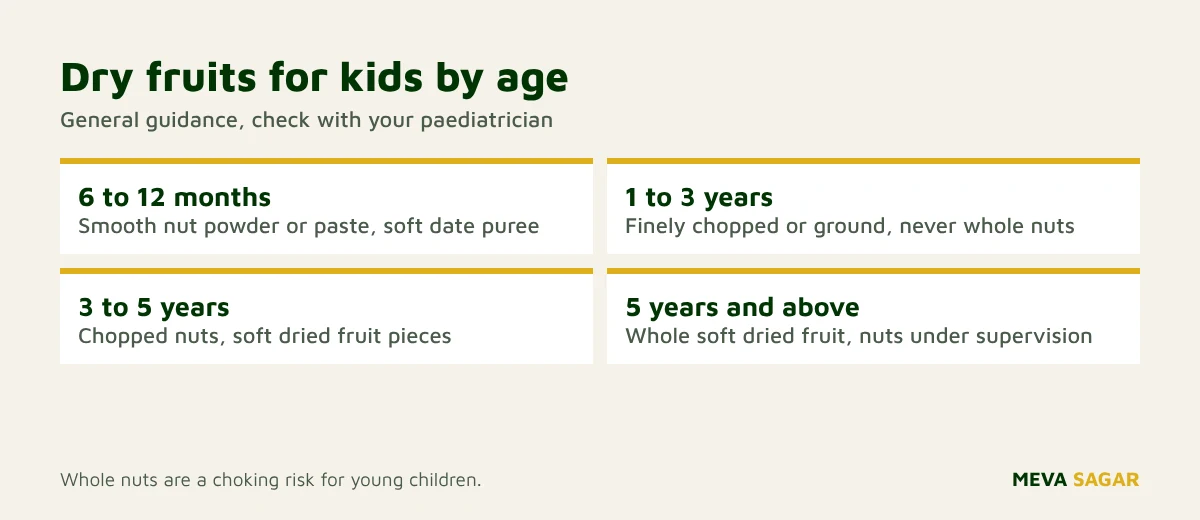
Age-wise guide
| Age | Safe form | Amount | Avoid |
|---|---|---|---|
| 6 to 12 months | Fine powder or smooth paste mixed into food; soft date or fig puree | ¼ to 1 teaspoon powder | Whole or chopped nuts, honey (under 12 months), raisins whole |
| 1 to 3 years | Powder, paste, finely chopped soft dried fruit | 1 to 2 teaspoons powder; 1 to 2 chopped dates | Whole nuts, large pieces, sticky whole raisins |
| 3 to 5 years | Finely chopped nuts, soft dried fruit cut small | 1 tablespoon chopped nuts; 2 to 3 pieces dried fruit | Whole hard nuts, popcorn-style snacking |
| 5 to 8 years | Chopped or sliced nuts, small whole soft nuts under supervision | A small handful (15 to 20 g) | Eating while running or laughing |
| 8 years and above | Most forms, as part of balanced meals | A handful (20 to 30 g) | Salted and sugar-coated mixes |
Honey should not be given to children under 12 months, because of the risk of infant botulism. Use dates or ripe banana to sweeten baby food instead. Learn more in our guide to dates and nut energy balls for older kids.
Best dry fruits for children and why
- Almonds: vitamin E, calcium and protein. Soak, peel and grind for babies.
- Walnuts: omega-3 fat, supporting brain growth. Finely ground.
- Cashews: soft, mild and easy to blend into milk or porridge.
- Dates: natural sweetness, fibre and some iron. A good replacement for sugar.
- Raisins: iron and sweetness. Chop for small kids because they are sticky.
- Figs: fibre, helpful when constipation occurs. Soak and mash.
- Apricots and prunes: gentle on the tummy, soft when soaked.
You can find fresh stock in our nuts range and dates range.
Choking and allergy precautions
These matter more than any nutrition detail.
- Never give whole nuts to under-fives
Pieces can enter the windpipe. Chop, grind or use butter thinned with milk. - Seat the child
Children should sit still and upright while eating. Never give nuts to a child who is walking, running or lying down. - Introduce one nut at a time
Wait three days between new nuts so that any reaction is clear. - Know the signs of allergy
Hives, swelling of lips or face, vomiting or wheezing soon after eating. Call your doctor or emergency services straight away. See tree nut allergy. - Watch the sugar
Choose unsweetened dried fruit and avoid candied or chocolate-coated products.
Easy dry fruit ideas for kids
- Nut powder in milk: blend almonds, cashews and a pinch of cardamom, and add a teaspoon to warm milk.
- Date and banana mash: a good first food for toddlers.
- Energy balls: dates, oats and ground nuts rolled into small balls for children over three.
- Mixed fruit porridge: chopped figs and apricots stirred into oats.
- Lunchbox: a small pouch of chopped nuts and raisins for children over five.
Try our dry fruit milkshake for older children, and skip any added sugar.
What about brain-boosting claims?
Almonds and walnuts are often marketed as "brain foods" for children. Walnuts do supply omega-3 fat and almonds give vitamin E, which contribute to a healthy diet. But no single food makes a child smarter. Good sleep, regular meals, play and reading do far more. Treat dry fruits as one small piece of a balanced diet.
Following official guidance
Guidance on infant feeding changes with research, so always check with your paediatrician. For general healthy-eating principles, the WHO healthy diet fact sheet recommends limiting free sugars and choosing nuts and fruit over processed snacks, which fits well with the plain, unsweetened dry fruits discussed here.
Picky eaters and lunchboxes
Some children refuse nuts because of the texture. Try grinding them into a powder and stirring into dal, roti dough or pancake batter. For lunchboxes, a small pouch of chopped almonds, raisins and a few seedless dates makes a better snack than packaged biscuits. Do not force the child to eat. Offer small portions repeatedly, and they will often accept them in time. Always supervise young children while eating.
Fresh dry fruits for the family
Almonds, cashews, dates and raisins in sealed packs.
Frequently asked questions
At what age can I give dry fruits to my baby?
Around six months, once solids have started, in a safe form such as fine powder or smooth paste mixed into food. Never give whole nuts. Talk to your paediatrician if there is allergy in the family.
How many almonds can a child eat per day?
For a toddler, one to two teaspoons of ground almonds. For a child of five or older, four to six chopped or soaked almonds is common. Adjust for appetite and the other nuts in the day.
Should I soak almonds for kids?
Soaking softens almonds and makes the skin easy to remove, which is helpful for babies. It is not essential for older children, who can chew chopped almonds.
Are raisins safe for toddlers?
Whole raisins are sticky and can be a choking hazard under three. Chop them or soak and mash them for toddlers.
Can kids eat dry fruits every day?
Yes, in small amounts, if there is no allergy. A teaspoon of ground nuts or a few chopped pieces a day fits most children.
Which dry fruits are best for children's brain development?
Walnuts for omega-3 and almonds for vitamin E are popular, but no single food boosts intelligence. Treat them as part of a balanced diet along with sleep and play.
Is honey safe for babies?
No. Honey should not be given to children under 12 months because of the risk of infant botulism. Use mashed dates or ripe banana for natural sweetness.
What if my child is allergic to nuts?
Avoid all tree nuts and ask your doctor about testing and an action plan. Dates, raisins, figs and apricots may still be fine, but check the label for cross-contamination.
The bottom line
Dry fruits can be a small, tasty source of energy and nutrients for children when they are served in an age-appropriate form. Grind or chop for the little ones, introduce allergens carefully and keep the sugar low. Related reading: energy balls and dry fruits in pregnancy.