Newborn weeks are tiring, and many mothers ask about dry fruits for breastfeeding: are almonds and dates helpful, do gond laddus increase milk, what should be avoided? Breastfeeding raises calorie and nutrient needs, and nuts and dried fruits are convenient, nourishing snacks to eat one-handed while holding a baby. At the same time, no dry fruit has been proven to increase milk supply, and traditional postpartum sweets can be very rich in sugar and ghee. This guide covers what to eat, how much, what the evidence says about milk and what to watch for in you and your baby.
Quick answer: Breastfeeding mothers need roughly 330 to 400 extra kcal a day, plus fluids and nutrients. A handful of almonds, walnuts and dates, soaked figs and makhana makes a convenient, nourishing snack. No dry fruit has been proven to boost milk supply, which depends mainly on frequent, effective feeding. Watch for baby reactions, avoid large amounts of sugar and ask your doctor about supplements.
Extra needs while breastfeeding
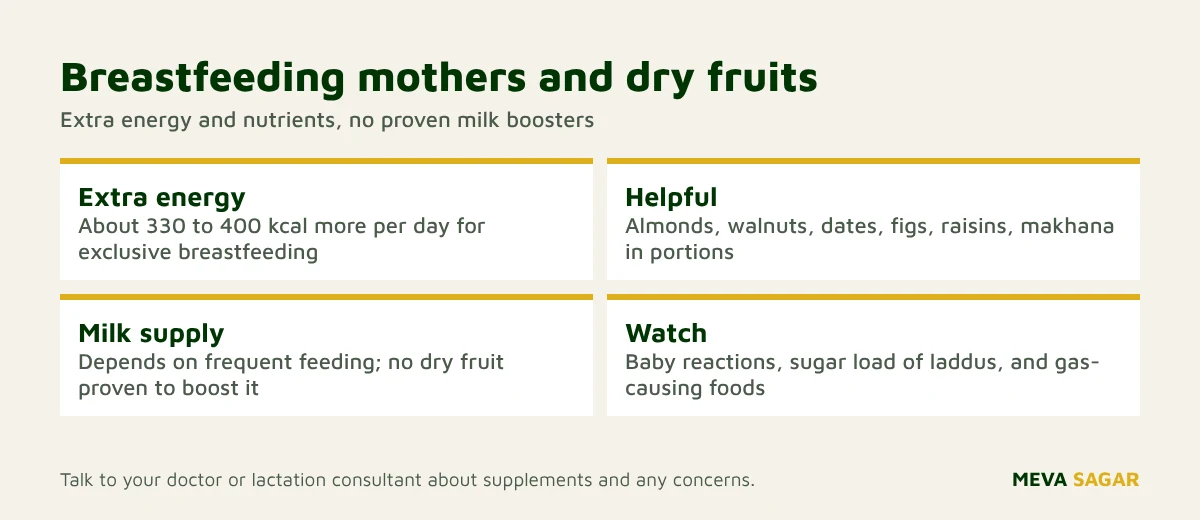
Producing milk uses energy and nutrients. The WHO healthy diet guidance and national guidelines recommend extra energy of around 330 to 400 kcal a day during exclusive breastfeeding, plus protein, iron, calcium, iodine, vitamin A, B12, folate and enough fluids. Many mothers also lose sleep and skip meals, so convenient snacks matter. Breast milk quality is robust; the mother body protects it by drawing on her own stores, so poor diet affects the mother more than the baby. See NIH on calcium and NIH on iron.
Dry fruits that help
| Dry fruit | What it offers | Notes |
|---|---|---|
| Almonds | Protein, vitamin E, magnesium, calcium | 6 to 10 a day, soaked or plain |
| Walnuts | ALA omega-3 and energy | 4 to 5 halves |
| Dates | Energy, iron, potassium, fibre | 2 to 3 a day; a classic postpartum food |
| Figs and prunes | Fibre; help constipation common after birth | 2 to 3 pieces |
| Raisins | Iron, potassium | Small handful |
| Makhana | Light, calcium, easy to digest | A cup roasted |
| Cashews and pistachios | Energy, zinc, B6 | A small handful |
See benefits of dates and makhana benefits. Nutrient values from USDA FoodData Central.
Do dry fruits increase milk supply?
Milk supply depends mainly on how often and how well the baby feeds and the breast is emptied. Foods and herbs called galactagogues, such as fenugreek, fennel, oats and nuts, are popular, but evidence that they raise supply is weak. A well-fed mother with enough fluids is more likely to feel well and able to feed. If you worry about low supply, a lactation consultant can check latch, feeding frequency and baby weight gain. Dry fruits can be part of a good diet but should not be seen as a milk booster.
Traditional postpartum foods
Panjiri, gond laddus, dink laddus, dry fruit halwa and ajwain or methi preparations are common after delivery in India. Many are nourishing but dense in ghee and sugar. A healthier version uses less sugar or jaggery, includes oats, whole wheat, nuts and seeds and is eaten in small portions. If you have gestational diabetes or are gaining excess weight, ask your doctor or dietitian how to adapt them. See panjiri recipe and dry fruit laddu recipe.
A daily eating plan
- On waking
A glass of water and 2 soaked figs or prunes. - Breakfast
Oats or paratha with curd and chopped almonds. - Mid-morning
Fruit and 8 to 10 almonds or a date with a walnut. - Lunch
Dal, vegetables, roti or rice and curd or buttermilk. - Evening
Roasted makhana or a small handful of mixed nuts. - Dinner
Light, protein-rich meal; a glass of warm milk if you like.
Keep water handy at every feed. See how many dry fruits per day.
Allergies and baby reactions
- If there is a strong family history of nut allergy, ask your paediatrician about maternal nut intake; current advice generally does not restrict maternal diet unless the baby reacts.
- Watch for rash, blood in stool, vomiting or severe colic after you eat a new food; if present, talk to your doctor.
- Gas-causing foods affect some babies; track and adjust if you notice a pattern.
- Large amounts of dried fruit can loosen your stools and, rarely, the baby stools.
- Introduce one new food at a time.
See tree nut allergy for background.
Cautions
- Dry fruits are calorie-dense; a very large intake can slow postpartum weight loss.
- Sugar-rich sweets can spike blood sugar; moderate portions.
- Avoid unpasteurised or untested herbal mixtures.
- Ask your doctor before taking iron, calcium or vitamin D supplements.
- If you feel very low or anxious, speak to your doctor; postpartum depression is common and treatable.
Hydration matters more than any single food.
Myths and common mistakes
| Myth or mistake | Reality |
|---|---|
| Almonds and dates make milk | No proven effect on supply |
| Eat for two | You need extra calories, not double |
| Cold fruits harm milk | There is no such effect |
| Spicy food always upsets baby | Most babies tolerate it |
| Heavy ghee laddus are necessary | Moderate portions work and are lighter |
Rest, support and realistic expectations
The first weeks of breastfeeding are demanding, and food is only one part of recovery. Accept help with cooking and housework, sleep when the baby sleeps and ask your family to bring snacks and water to where you feed. If feeding hurts, if you are worried that the baby is not getting enough milk or if you have fever or breast pain, talk to your doctor or a lactation consultant early. Support and good technique solve more problems than any food.
Be kind to yourself about weight. Gradual postpartum weight loss, around half a kilogram a week at most, is considered safe while breastfeeding. Crash diets can reduce energy and may affect milk supply. A balanced diet with nuts, fruit, pulses and dairy helps you recover steadily.
Easy snack ideas for one-handed eating
Keep small boxes of nuts and dates within reach of your feeding chair, a flask of water and a few pre-soaked figs in the fridge. Roast makhana in batches and store in an airtight jar. Prepare energy balls from dates, nuts and oats that you can grab in a moment. These need no preparation at 3 am and give steady energy. See dates and nuts energy balls for a simple recipe.
Frequently asked questions
Which dry fruits are good for breastfeeding mothers?
Almonds, walnuts, dates, figs, raisins and makhana give energy and minerals. Eat a mix in moderate portions.
Do dry fruits increase breast milk?
No dry fruit has been proven to. Frequent feeding and enough food and fluids matter most.
How many dates can a breastfeeding mother eat?
Two to three dates a day is typical, within a balanced diet.
Can I eat nuts while breastfeeding?
Yes, unless you are allergic. Watch your baby for reactions if there is a family history of allergies.
Are gond laddus safe after delivery?
In moderate portions they are fine for most women, but they are rich in ghee and sugar. Ask your doctor if you have diabetes.
How many extra calories do I need?
Around 330 to 400 kcal a day during exclusive breastfeeding, from nutritious foods.
The bottom line
Dry fruits for breastfeeding mothers are a nourishing, convenient snack, not a milk booster. Eat a balanced mix of almonds, walnuts, dates, figs and makhana, drink plenty of water, watch your baby for reactions and lean on your doctor or a lactation consultant for any worries.