
The main benefits of cashews are that they are a soft, easy-to-eat source of healthy fats, plant protein, magnesium, copper and zinc, and that they make vegetarian cooking richer without cream. They are creamier and sweeter than almonds, which is why kids and older people like them. They are also higher in carbohydrate and lower in fibre than most other nuts, so they are best enjoyed in measured handfuls.
Quick answer: About 15 to 18 cashews (30 g) a day is a sensible portion for most healthy adults. Choose plain, unsalted or lightly roasted cashews, and count them as a snack. Cashews are not a weight-loss food, but they are not a "fattening" one either if you keep to the handful.
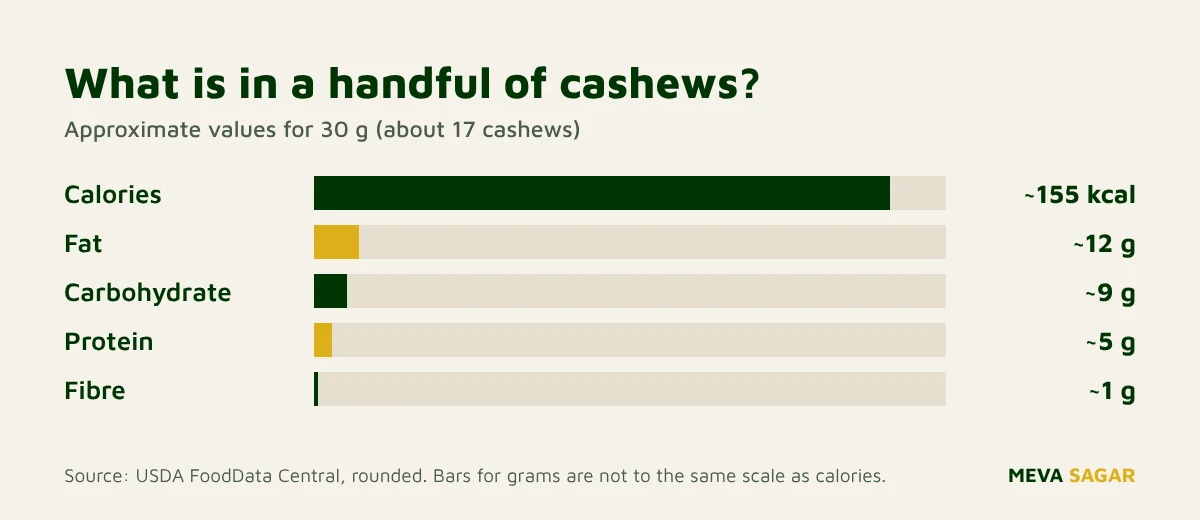
What is in a handful of cashews?
Cashew (kaju) is the kernel that hangs below the cashew apple. The shell contains an irritating oil, which is why raw cashews in shell are never sold, and why even "raw" cashews on the shelf have been steamed or heated once to remove it. Per USDA FoodData Central, 30 g gives you roughly the following. The figures are rounded, and vary a little by crop.
Cashews are a good source of copper and a decent source of zinc, iron and phosphorus. They have less fibre than almonds (about 1 g against 3.5 g), which is one reason they feel softer and less filling. The mineral to know about is magnesium. The US NIH explains daily needs on its magnesium fact sheet.
Benefits of cashews: what the evidence supports
1. Heart-friendly fats
Most of the fat in cashews is monounsaturated, with some polyunsaturated. Studies on nuts as a group, including cashews, tend to show modest improvements in blood cholesterol when they replace refined snacks or saturated fat. Cashews themselves have fewer trials than almonds or walnuts, so we would call the evidence supportive, not strong.
2. Minerals your body uses every day
Copper helps iron do its job and supports the nervous system. Magnesium is involved in muscles and energy production. Zinc supports immunity. A handful gives a useful top-up of all three, which matters if your diet is mostly rice and wheat.
3. A good plant-based base for cooking
Soaked and ground, cashews give gravies, kheer and vegan "cream" a silky body without dairy. This is why they sit at the heart of shahi paneer, korma and kaju katli. It is a practical benefit: you can make rich food with less cream.
4. Easy on the teeth and stomach
The soft texture makes cashews one of the easiest nuts for older people and children (chopped, never whole for small children). Many people who find almond skin harsh do well on cashews.
5. What cashews do not do
You will see claims that cashews cure anaemia, build bone density on their own or melt belly fat. They do not. They are a good everyday food and nothing more mysterious than that.
Cashews are comfort food that happens to be good for you. Keep it to a handful and enjoy it.
How many cashews should you eat per day?
Think in handfuls. A 30 g serving is 15 to 18 cashews, and that is the amount used in nutrition tables. Because cashews are higher in carbohydrate than other nuts, people who watch their blood sugar often prefer to keep the portion nearer 10 to 12.
| Who | Reasonable daily amount | Note |
|---|---|---|
| Healthy adult | 12 to 18 cashews | A snack on its own or with fruit |
| Trying to lose weight | 8 to 12 cashews | Swap, do not add. See our weight-loss guide |
| Active or training | 18 to 25 cashews | Pair with a fruit before exercise |
| Children without allergy | 3 to 5, chopped or ground | Whole nuts are a choking risk |
| Older adults | 10 to 15, soaked if needed | Soft and easy to chew |
These are practical ranges, not medical advice. If you manage diabetes, kidney disease or take regular medication, ask your doctor or dietitian what suits you.
Cashews vs almonds vs walnuts
People often ask which is "best". The honest answer is that they do different things, so a mix is better than a favourite.
| Per 30 g | Cashews | Almonds | Walnuts |
|---|---|---|---|
| Calories | ~155 | ~170 | ~185 |
| Protein | ~5 g | ~6 g | ~4 g |
| Fibre | ~1 g | ~3.5 g | ~2 g |
| Standout | Copper, softness | Vitamin E, fibre | Plant omega-3 (ALA) |
| Best for | Cooking, kids, older adults | Daily snacking | Breakfast, heart-focused diets |
For more on the other two, see our guides to almonds and walnuts.
Cashew grades: what do W180, W240 and W320 mean?
The "W" stands for "whole", and the number is roughly how many whole kernels make up one pound (454 g). So a smaller number means bigger cashews. W180 is the largest and most expensive, W320 is the most common size, and splits and pieces are broken kernels. The nutrition is the same for all grades, so you are paying for size and looks.
| Grade | Size | Best for |
|---|---|---|
| W180 Jumbo | Largest, very uniform | Gifting, special occasions |
| W240 | Large, plump | Daily snacking, roasting |
| W320 | Medium, the everyday size | Cooking and snacking |
| Splits | Half kernels | Gravies, sweets, baking |
| Pieces | Small broken bits | Pastes, kaju katli base, fillings |
Browse the full cashew range if you want to compare them.
How to choose and store good cashews
- Look for pale ivory kernels with a uniform colour. Yellow-brown spots and a dull surface mean they are old.
- Smell them: a clean, faintly sweet and buttery smell is good. A sharp, oily or paint-like smell is rancid.
- Taste one. Fresh cashews are mildly sweet and crisp or soft, never bitter or soapy.
- Keep them in an airtight jar away from heat and sunlight. In humid weather, store them in the fridge.
- Check the pack for a packing date and an FSSAI licence number.
Cashews have a high fat content and go stale faster than almonds, so buy in quantities you will finish in two or three months.
Who should be careful with cashews?
- Tree nut allergy: tree nut allergy is common and can be serious. Cashew allergy in particular can cause severe reactions in small amounts.
- Kidney stones: cashews contain some oxalate. People advised to limit oxalate should ask their doctor.
- Weight goals: a handful is fine, but salted or masala cashews add sodium and calories quickly.
- Diabetes: cashews are higher in carbohydrate than almonds. Stick to a measured portion.
Frequently asked questions
How many cashews can I eat in a day?
For most healthy adults, 12 to 18 cashews (about 30 g) is a sensible amount. If you are watching weight or blood sugar, 8 to 12 is easier to fit in.
Are cashews good for weight loss?
They are calorie-dense, so they do not help by themselves. A small portion can keep you full, but you need to replace another snack, not add to it.
Are cashews better than almonds?
Neither is better overall. Almonds have more fibre and vitamin E, cashews have more copper and a softer texture. A mix gives you both.
Can diabetics eat cashews?
In small portions, yes, as part of a balanced diet. Cashews have more carbohydrate than almonds, so keep to about 10 to 12 and check with your doctor or dietitian.
Is it better to eat cashews raw or roasted?
Both are fine. Dry-roasted cashews have a stronger flavour. Avoid oil-roasted or heavily salted ones if you watch sodium.
What do W180 and W240 mean on cashews?
They show the count of whole kernels in a pound. A smaller number means bigger cashews. Nutrition does not change.
Can I give cashews to children?
Yes, if there is no nut allergy, but chop or grind them for young children because whole nuts are a choking risk.
How should I store cashews?
Keep them in an airtight container in a cool, dark place, or in the fridge in humid weather. Discard them if they smell sharp or taste bitter.
The bottom line
Cashews are soft, tasty and quietly useful: minerals, good fats and a way to make home cooking richer. Keep the handful small, pick fresh, plain kernels and mix them with other nuts. Next, read about dry fruits names in English and Hindi or learn how to store dry fruits so they stay fresh.


