

Folate, or vitamin B9, is vital for making DNA and new cells, and it is especially important before and during early pregnancy to prevent neural tube defects. When people ask about folate in nuts, the answer is that peanuts and walnuts are decent sources, almonds moderate, and most dried fruits low, while lentils, beans and leafy greens do the heavy lifting. This guide ranks nuts and dried fruits for folate, compares them with dal and greens, explains daily needs and the role of folic acid supplements, covers cooking losses and offers practical meal ideas for women planning pregnancy and anyone wanting to raise intake.
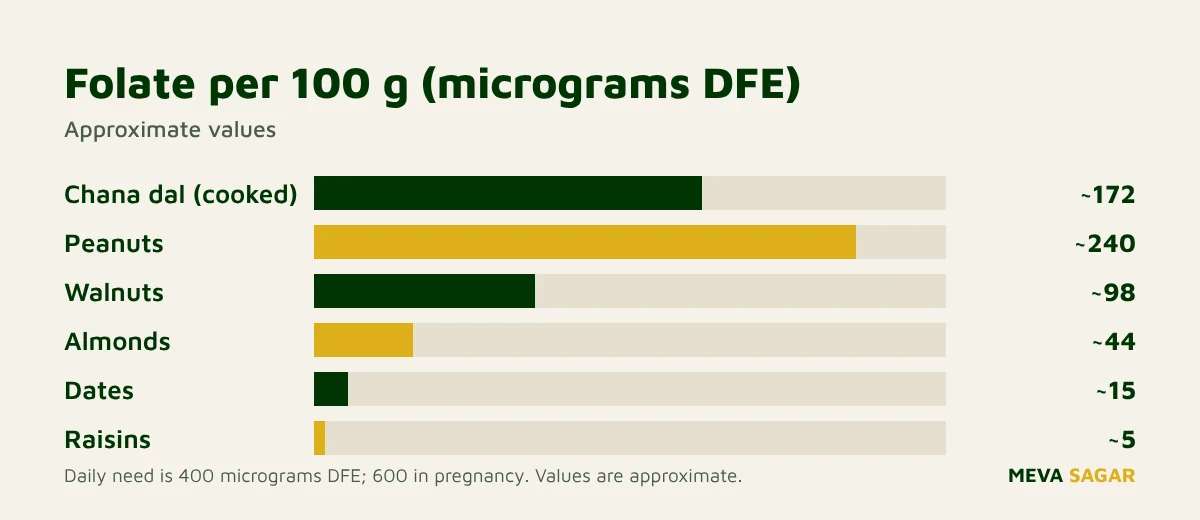
Quick answer: Peanuts (about 240 micrograms per 100 g) and walnuts (about 98) are the best nuts for folate, almonds give about 44, and dried fruits very little. Adults need 400 micrograms DFE a day, and 600 during pregnancy. Dal, spinach and fortified grains are richer sources. Women planning pregnancy are usually advised to take folic acid supplements as directed by their doctor.
Why folate matters
Folate is needed to build DNA and to make red blood cells. A shortage can cause megaloblastic anaemia, with tiredness and pale skin. During early pregnancy, low folate raises the risk of neural tube defects such as spina bifida, which develop in the first weeks, often before pregnancy is known. This is why health authorities recommend folic acid supplementation for women who may become pregnant. See the NIH folate fact sheet and folate for background. Folate occurs naturally in food, while folic acid is the stable synthetic form used in supplements and fortified foods.
Daily needs
| Group | Recommended intake (mcg DFE) |
|---|---|
| Adults | 400 |
| Women planning pregnancy | 400 from supplement plus diet, as advised |
| Pregnancy | 600 |
| Breastfeeding | 500 |
| Children 4 to 8 years | 200 |
| Teenagers 14 to 18 years | 400 |
DFE stands for dietary folate equivalents. Your doctor may recommend a higher dose of folic acid if you have a history of a neural tube defect, diabetes or take certain medicines.
Folate in nuts and dried fruits
| Food (30 g) | Folate (mcg DFE, approx) | % of 400 mcg |
|---|---|---|
| Peanuts | ~72 | ~18% |
| Walnuts | ~29 | ~7% |
| Almonds | ~13 | ~3% |
| Hazelnuts | ~34 | ~8% |
| Pistachios | ~15 | ~4% |
| Cashews | ~7 | ~2% |
| Dates (2) | ~6 | ~1.5% |
| Raisins | ~1 | ~0% |
Source: USDA FoodData Central. See walnut halves and hazelnuts for products.
How nuts compare with dal and greens
| Food | Serving | Folate (mcg DFE, approx) |
|---|---|---|
| Cooked chana dal | 1 cup | ~280 |
| Cooked rajma | 1 cup | ~230 |
| Cooked spinach | 1 cup | ~260 |
| Cooked moong dal | 1 cup | ~320 |
| Peanuts | 30 g | ~72 |
| Walnuts | 30 g | ~29 |
| Orange | 1 medium | ~55 |
Pulses and greens are the real folate stars. Nuts help, but should not be the main plan. A cup of dal gives as much folate as more than a hundred grams of nuts.
Folate before and during pregnancy
If you are planning a pregnancy, speak to your doctor about folic acid, usually started at least one month before conception and continued through the first trimester. Food alone is rarely enough to reach the protective level, because natural folate is less well absorbed than folic acid. Eat dal, greens, citrus fruit and nuts as part of a balanced diet, and use fortified atta or cereals if available. See dry fruits during pregnancy for safe choices.
Cooking and storage losses
Folate is sensitive to heat, light and water. Boiling vegetables in a large amount of water and discarding it can lose half or more of the folate. Pressure cooking dal retains more because less water is lost. Steaming greens briefly and using the cooking liquid in soups helps. Nuts are eaten raw or lightly roasted, so they retain most of their folate, though long storage can reduce levels slightly. Keep nuts in a cool, dark place. See how to store almonds, cashews and walnuts.
Easy ways to boost folate
- Start the day with a moong dal chilla topped with chopped walnuts.
- Add spinach and peanuts to poha or upma.
- Eat an orange or a glass of fresh citrus juice with meals.
- Include rajma, chana or lobia several times a week.
- Use fortified flour where available.
- Take folic acid if advised by your doctor.
Folate and other B vitamins
Folate works with vitamin B12 and B6. Vegetarians and vegans are at higher risk of low B12, and high folate intake can mask the anaemia caused by B12 deficiency while nerve damage progresses. This is why a doctor may check B12 along with folate. Nuts contribute some B6, especially pistachios and walnuts; see NIH on vitamin B6. A varied diet and periodic blood checks are a safe approach for vegetarians.
Myths and common mistakes
| Myth or mistake | Reality |
|---|---|
| Dry fruits supply enough folate | They supply little; dal and greens do more |
| Folic acid is only for pregnancy | It helps anyone with low folate |
| More is always better | Very high doses can mask B12 deficiency |
| Boiling keeps folate | Water-soluble folate leaches out |
| Start folic acid after a positive test | Neural tube closes early, so start before conception |
Talk to your doctor about your own needs.
Folate-friendly Indian dishes
Many everyday dishes are naturally rich in folate when they use pulses and greens. Moong dal khichdi with spinach, palak dal, rajma chawal, chana masala, sprouted moong salad and besan chilla all deliver 100 to 300 micrograms per serving. Adding a spoonful of chopped walnuts or crushed peanuts for crunch adds a little more. Lemon juice or amla chutney on the side supplies vitamin C, which helps protect folate in the gut. Compared with trying to meet your needs through nuts alone, these dishes are cheaper, tastier and far more effective.
Folate during breastfeeding and in older age
Folate needs rise again during breastfeeding, to about 500 micrograms DFE, because the vitamin is secreted into milk. In older adults, absorption can fall, and some medicines, such as methotrexate and certain anti-seizure drugs, interfere with folate use. Alcohol also reduces folate status. If you take such medicines or drink regularly, ask your doctor whether testing or supplementation is appropriate. For most people, a diet that regularly includes pulses, greens, citrus fruit and nuts is enough.
Testing and treating low folate
A simple blood test can measure serum or red blood cell folate, often alongside vitamin B12 and a complete blood count. If levels are low, doctors usually prescribe folic acid tablets for a few months and review the diet. Causes include poor intake, alcohol use, malabsorption, pregnancy and certain medicines. Treating low folate without checking B12 can hide a B12 problem, so tests are best done together. Bring a list of everything you take, including supplements.
Frequently asked questions
Which nuts are highest in folate?
Peanuts, then walnuts and hazelnuts. Almonds and cashews have less.
Do dried fruits contain folate?
Very little. Dates and raisins contribute only a few micrograms.
How much folate do I need in pregnancy?
600 micrograms DFE a day, usually with folic acid supplements as directed by your doctor.
Are nuts enough to prevent neural tube defects?
No. Supplements started before conception are recommended, along with a folate-rich diet.
Does cooking destroy folate?
Boiling and discarding the water can lose a lot. Steaming and pressure cooking retain more.
Can I take too much folic acid?
High doses can mask B12 deficiency, so follow your doctor's advice.
The bottom line
Folate in nuts is useful but modest. Rely on dal, greens and fortified foods, add peanuts and walnuts for extra, and ask your doctor about folic acid if pregnancy is planned.


